The ceiling of the Sankt Michaelis Church in Hildesheim
Hildesheim is a town a little to the south of Hannover, with some very exquisite churches in the romanesque style, with inside some even more astonishing medieval art. in the cathedral one can see the Christ-Column (see here for more on this) and the so called bernward-doors, but her i want to tell more about another of the churches, the Saint Michaels church.

Saint Michaels Church
The church is built in an Ottonian romanesque style, and the building was begun around 1010 by the bishop Bernward, who is also buried in the church. The church has a long nave.

The Ceiling: The tree of Jesse
The main focus of this page is the ceiling of the nave, which has as theme the tree of Jesse. it was made around the year 1200 (although some parts have been renewed or replaced during the history)
Below there is the full view of the roof.

The ‘tree of Jesse’ is a theme in many stained glass in cathedrals and churches, beginning in the 11th century in Saint-Denis and Chartres. Given this ceiling is from 1200, it counts as one of the earlier, without a tradition yet settled.
Some parts are easy to know which person or symbol is referred to, but many are hard or very hard, so luckily i found 2 articles with a lot of information by people who are a lot more specialised, namely Andreas Lemmel and Volkmar Keil. these articles were very helpful, at the bottom there are 2 links to the articles for who wants to read more, but they are in the german language.
The tree of Jesse is the genealogy of Jesus, Jesus was descendant of king David (son of Jesse), as was foretold by the prophet Isaiah Is 11:1): “A shoot will spring forth from the stump of Jesse, and a branch will grow from his roots.”.
In the new testament 2 Gospels mentions the genealogy of Jesus, Matthew and Luke.
First there is Matthew, who starts his Gospel with the genealogy of Jesus, starting with Abraham, through David, then the kings to Joseph, in 42 generations, nicely divided in 3 x 14, 14 from Abraham to David, 14 from David to the exile to Babylonia and 14 up to Christ.
Luke starts with Jesus and goes all the way up through David and Abraham, but then continues to Adam and so God himself, up to a total of 77 generations
The numbers are symbolic, as 7 is a holy number, so these should not be treated as historic lists the way we do now. Even more so, because the 2 lists differ. Where Matthew’s list runs through Salomo and the other Kings of Israel/Judah, Lukes list runs through another son of David, Nathan (not to be confused with the prophet close to David). Why the difference? one explanation tells that the one of Luke actually tells the line through Mary, and Matthew through Joseph. another is that Matthew stresses the line of Kings, Luke a priestly line, as Jesus is both the highest king and highest priest. The interesting thing of the Hildesheim painting is, that both lines are represented. others will often take the line from Matthew with the kings (for example in the Pamelechurch in Oudenaarde (see here)), but here they are both shown. off course they don’t contain each generation, they omit some along the line. below i have made a legend with each figured marked, if you want to go directly to the detailed picture and explanation, please click on the number next to the picture.

general outline
The ceiling Starts with Adam and Eve in the garden of Eden (G1 ) the big central scene at the bottom (westside). it goes then through the yellow G figures, first below, then upwards jumping from the left to the right in a non regular way untill it goes back to the middle with Jesse G21 and David G22 who is surrounded by four psalmists (Ps). The line followed in Lukes Gospel is continued on the side and top, again jumping left and right withe figures marked with L, the big figures in the middle follow the line from Matthew through Salomon M1 with the fourteen kings of Judah, represented by2 bigger ones and 12 unnamed kings around (K ) marked in orange. the ‘tree’ ends with Mary (M ) Surrounded by 4 virtues V and an enthroned Jesus Christ (Pantokrator) JC . around the garden of Eden are 4 figures pouring water, representing the 4 rivers surrounding the garden (R) while around the figure of Jesus Christ are 4 Archangels (A ). on the sides of the big central scenes are also other figures of prophets P and other figures foreboding Christ, though it is often not sure which figure exactly. At the four corners of the ceiling we find the four evangelists E (inside) and their symbols E s on the outside.
Jump to details link list
Before we go into each of the figures in detail let’s take a closer overview look from the bottom up
First, Adam and Eve in the garden of Eden centrally, the four rivers, Mark and Luke, a lion (symbol for Mark) and ox (symbol for Luke) among other forefathers

Above that is Jesse

King David with the psalmists

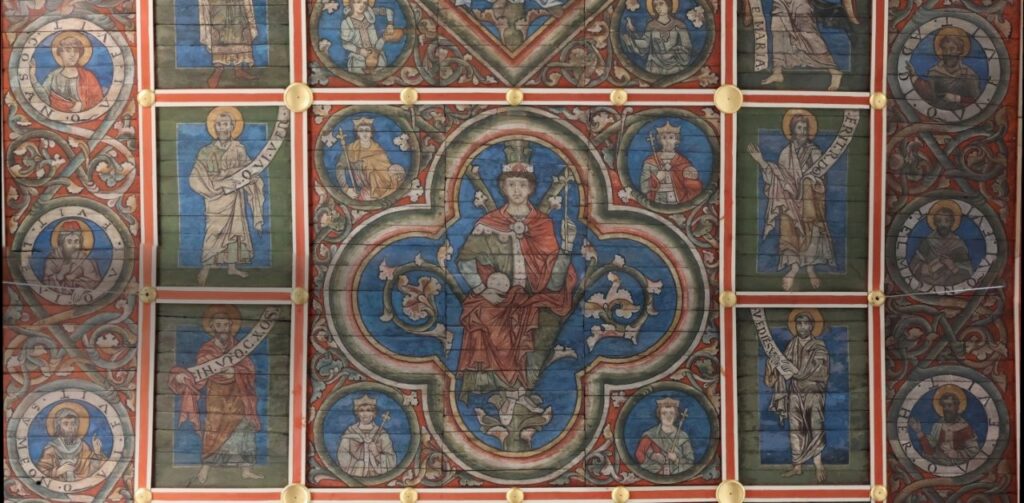
King Solomon (and other kings)

King Hizkia (and others kings)

King Josiah (apologies for this picture, it turned out later i had missed taking this picture central, so i had to stitch parts of two others together, which is visible unfotunately, if i ever get back in Hildesheim i will redo this picture)
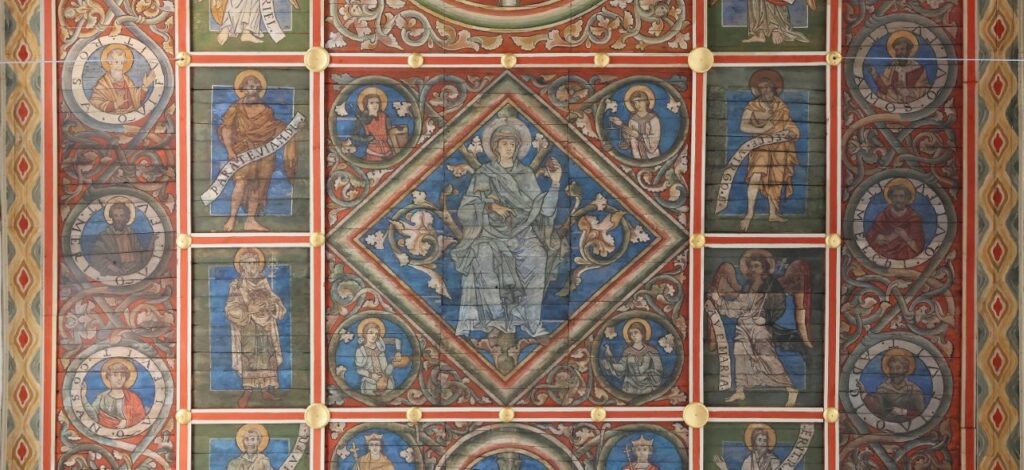
Mary and the four virtues
finally “Christ Pantokrator”, archangels, Matthew and John and man (symbol for Matthew) and an eagle (symbol for John)

The 4 Evangelists
let’s start in the corners, with the 4 evangelists, and their symbols.

Mark
In the lower left we have the evangelist Mark (E1)

On the right side we find the evangelist Luke E2 , with an ox in the background

E2s Symbol of Luke In thesame corner is a winged ox, symbol Luke, because Luke starts his gospel with the story of Zachary, John the baptist’s father offering in the temple as priest.

In the same corner is the symbol for Matthew an winged man or angel (E3s). This because Matthew starts his gospel with the genealogy of Jesus.

on the upper right we see the evangelist John E4 with an eagle watching

In the corner is the Symbol for John, an eagle E4s , as John starts his gospel with a treatise on wisdom, so one needs a higher point for view for that….
extra: what is the source for the 4 symbols of the evangelists
The 4 symbols were first named as by Irenaeus of Lyon (ca 122-202). and go back to the vision of Ezekiel and the book of Revelation.
In Ezekiel 1:10 it says the following: “As for their faces, each of the four had the face of a man, the face of a lion on the right side, the face of an ox on the left side, and the face of an eagle.” (from Biblegateway NCB)
In Apocalyps 4:6-7 : 6 and in front of the throne there was something like a sea of glass as transparent as crystal. In the center of the throne and around it there were four living creatures, and they were covered with eyes in front and in back. 7 The first living creature resembled a lion, the second resembled an ox, the third had a human face, and the fourth resembled an eagle in flight.
The genealogy
After the introductory evangelists, lets go into the line of ancestors of Jesus.
Below are the two version from the gospel of Matthew and the one from Luke with the represented ones marked with their location
Matthew 1:
1 This is the genealogy of Jesus the Messiah JC, the son of David, the son of Abraham:
2 Abraham G13 was the father of Isaac, Isaac G14 the father of Jacob,
Jacob G15 the father of Judah and his brothers,
3 Judah the father of Perez and Zerah, whose mother was Tamar,
Perez G16 the father of Hezron, Hezron the father of Ram,
4 Ram the father of Amminadab,
Amminadab the father of Nahshon, Nahshon G18 the father of Salmon,
5 Salmon the father of Boaz, whose mother was Rahab,
Boaz G19 the father of Obed, whose mother was Ruth, Obed G20 the father of Jesse,
6 and Jesse G21 the father of King David.
David G22 was the father of Solomon, whose mother had been Uriah’s wife,
7 Solomon M1 the father of Rehoboam, Rehoboam the father of Abijah, Abijah the father of Asa,
8 Asa the father of Jehoshaphat, Jehoshaphat the father of Jehoram, Jehoram the father of Uzziah,
9 Uzziah the father of Jotham, Jotham the father of Ahaz, Ahaz the father of Hezekiah,
10 Hezekiah M2 the father of Manasseh, Manasseh the father of Amon, Amon the father of Josiah,
11 and Josiah M3 the father of Jeconiah and his brothers at the time of the exile to Babylon.
12 After the exile to Babylon:
Jeconiah was the father of Shealtiel, Shealtiel the father of Zerubbabel,
13 Zerubbabel the father of Abihud, Abihud the father of Eliakim, Eliakim the father of Azor,
14 Azor the father of Zadok, Zadok the father of Akim, Akim the father of Elihud,
15 Elihud the father of Eleazar, Eleazar the father of Matthan, Matthan the father of Jacob,
16 and Jacob the father of Joseph, the husband of Mary, and Mary was the mother of Jesus who is called the Messiah.
17 Thus there were fourteen generations in all from Abraham to David, fourteen from David to the exile to Babylon, and fourteen from the exile to the Messiah.
From Biblegateway NCB
Luke 3
23 The Genealogy of Jesus.
When Jesus began his ministry, he was about thirty years old.
He was the son JC, as it was thought, of Joseph, the son of Heli L23,
24 the son of Matthat L22, the son of Levi L21, the son of Melchi L20,
the son of Jannai L19, the son of Joseph L18,
25 the son of Mattathias, the son of Amos L17, the son of Nahum,
the son of Esli, the son of Naggai,
26 the son of Maath, the son of Mattathias, the son of Semein,
the son of Josech, the son of Joda L16,
27 the son of Joanan, the son of Rhesa L15, the son of Zerubbabel,
the son of Shealtiel, the son of Neri, L14
28 the son of Melchi L13, the son of Addi L12, the son of Cosam L11,
the son of Elmadam L10, the son of Er L9,
29 the son of Joshua, the son of Eliezer, the son of Jorim L8,
the son of Matthat, the son of Levi L7,
30 the son of Simeon L6, the son of Judah L5,the son of Joseph L4,
the son of Jonam L3, the son of Eliakim,
31 the son of Melea L2, the son of Menna, the son of Mattatha,
the son of Nathan L1, the son of David G22,
32 the son of Jesse G21, the son of Obed G20, the son of Boaz G19,
the son of Sala, the son of Nahshon G18,
33 the son of Amminadab, the son of Admin, the son of Arni G17,
the son of Hezron, the son of Perez G16, the son of Judah,
34 the son of Jacob G15, the son of Isaac G14, the son of Abraham G13,
the son of Terah G12, the son of Nahor G11,
35 the son of Serug, the son of Reu, the son of Peleg,
the son of Eber G10, the son of Shelah,
36 the son of Cainan, the son of Arphaxad, the son of Shem G9,
the son of Noah G8, the son of Lamech G7,
37 the son of Methuselah G6, the son of Enoch G5, the son of Jared,
the son of Mahalaleel, the son of Cainan G4,
38 the son of Enos G3, the son of Seth G2, the son of Adam G1,
the son of God.
From Biblegateway NCB
Adam and Eve in the garden of Eden

G1 in the first we see Adam and Eve in the garden of Eden at the moment when the yeat the forbidden fruit, we see the the snake also in the middle tree, the tree of knowledge of good an evil. on the 2 sides is also a tree with Christ giving a blessing, pointing out that humanity is won back from sin by Christ
around the image are depicted four symbolic representations of the rivers flowing from the garden of eden as mentioned in Genesis 2:10-14: Pishon, Gihon, Tigris and Euphrates.
which one is represented where is impossible to settle with certainty… it is worth noting that this water is also a link to baptism, as Volkmar Keil points out the baptismal vont was below this image.
Bible text
Genesis 2:
10 A river watering the garden flowed from Eden; from there it was separated into four headwaters. 11 The name of the first is the Pishon; it winds through the entire land of Havilah, where there is gold. 12 (The gold of that land is good; aromatic resin and onyx are also there.) 13 The name of the second river is the Gihon; it winds through the entire land of Cush. 14 The name of the third river is the Tigris; it runs along the east side of Ashur. And the fourth river is the Euphrates.
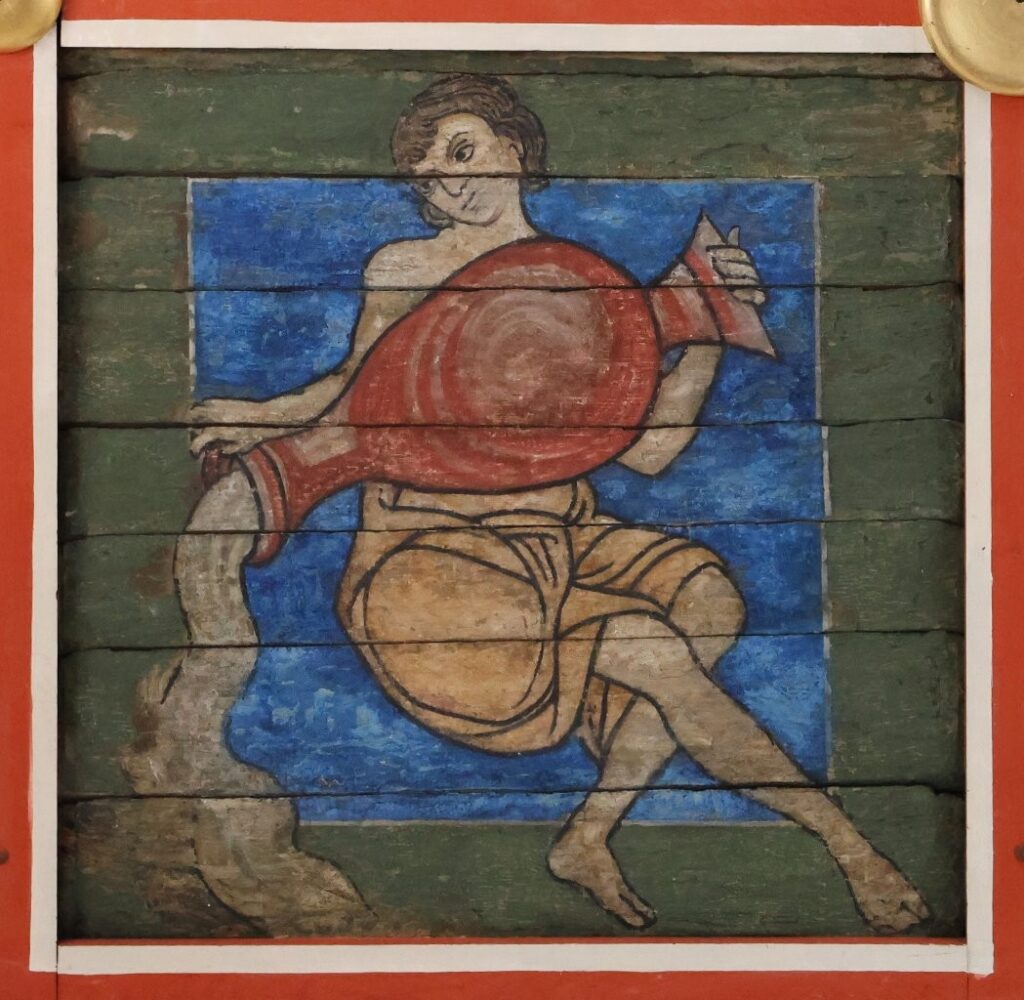
R1 one of the four paradise rivers

R1 one of the four paradise rivers

R3 third of the four paradise rivers

R4 last of the four paradise rivers
From Adam to Jesse
The Vulgate translation, which was for ages the standard version of the bible, has in the genealogy of Luke between each generation the words “qui fuit” – “who was” which is translated as “the son of” in the English translations. here it is used to identify the person rather the father.

First we go to the middle figure of the three below the depiction of Adam and Eve for Seth G2 , who was the third son of Adam and Eve (after Kain and Abel after Kain had murdered Abel and was banished afterwards)

To the left is Enos G3 Son of Seth.

on the right side of Seth is Cainan G4, grandson of Seth and son of Enos.

as first on the left side, going from the bottom is Enoch G5 , great grandson of Cainan

On the same height on the right side is Mathusalem G6 Enoch’s son

Back to the left one row up is Lamech G7, the son of Mathusalem

Back to right is Noah G8 Son of Lamech, who built the arc.

Back to the left is Sem G9. the eldest son of Noah.

Next is Sem’s great grandson Eber G10 , on the right side

we stay on the right side for Eber’s great-grandson Nachor G11

Nachor’s son Thare G12 is back on the left side

Back on the right side is Thare’s Son Abraham G13, one of Israels patriarchs, which are all three on the right side

Above is Abrahams son Isaac G14

Above is Isaac’s son Jacob G15

Back on the left at the same height of Abraham, is Phares G16 , Grandson of Jacob.

Above is Aram G17 , Phares’ grandson

And above is Aram’s grandson Nasson: G18
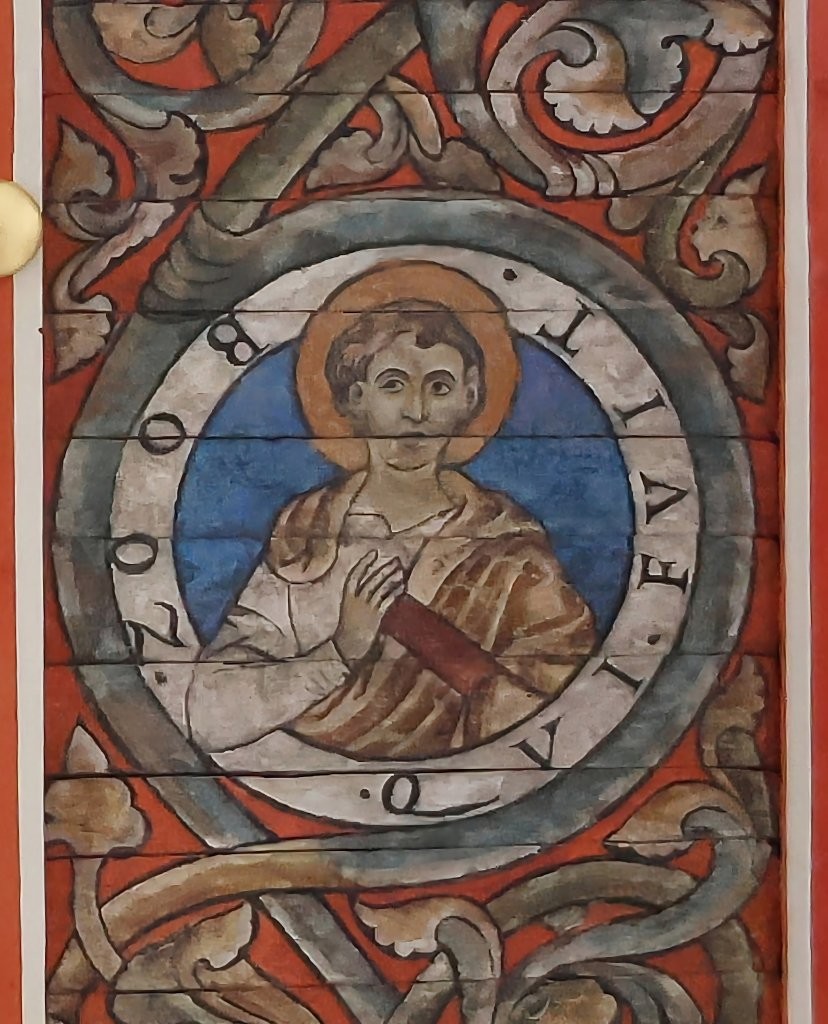
Back on the right is Boaz G19 Grandson of Nasson, Boaz marries the widow Ruth (see the book of Ruth)

Above is Obed G20 Boaz’ Son

Next we go two scenes down in the middle for Jesse G21 . Son of Obed.
Jesse is as usual depicted lying on a bed, with the tree rising up behind him
King David

Above Jesse is his youngest son King David G22 .
David was also known as composer of psalms that is why around him are four psalmists. according to titles of psalms and in 1 Chronicles 25 there are the names of 4 of the greatest of the temple singers are: Asaf, Hernan, Ethan and Jeduthun. it is impossible if these are the four depicted, and if so which of the four is who.

in the bottom left a psalmist (Ps1 )

another on the bottom right (Ps2)
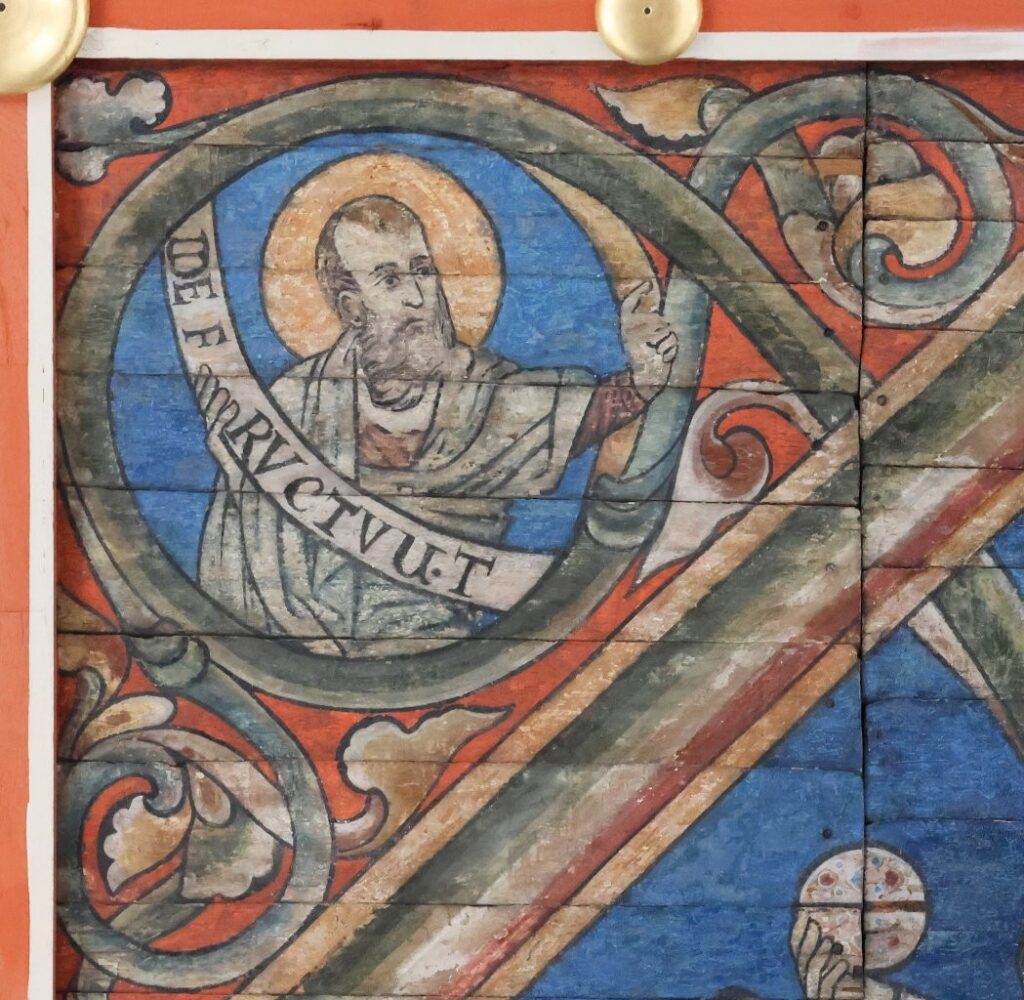
On the top left is a psalmist Ps3 with the text: “DE FRUCTU V[entris] T[ui ponam super sedem tuam]” from Psalm 131:11 in the Vulgate, in the NCB 132:11: “One of your own descendants, I will place on your throne.” (copied from Biblegateway). a promise that the descendants of David will be kings

the Psalmist Ps4 on the top right holds the text “Inveni David” from Psalm 88:21: “Inveni David, servum meum” in the Vulgate, Psalm 89:4 in the NCB translation (biblegateway): “I have sworn to my servant David”. again confirming the promise.
From here on the two genealogies differ, let’s first continue with the figures from Luke’s list, after that we follow the kings in the middle through the kings.
From David on: Luke’s line
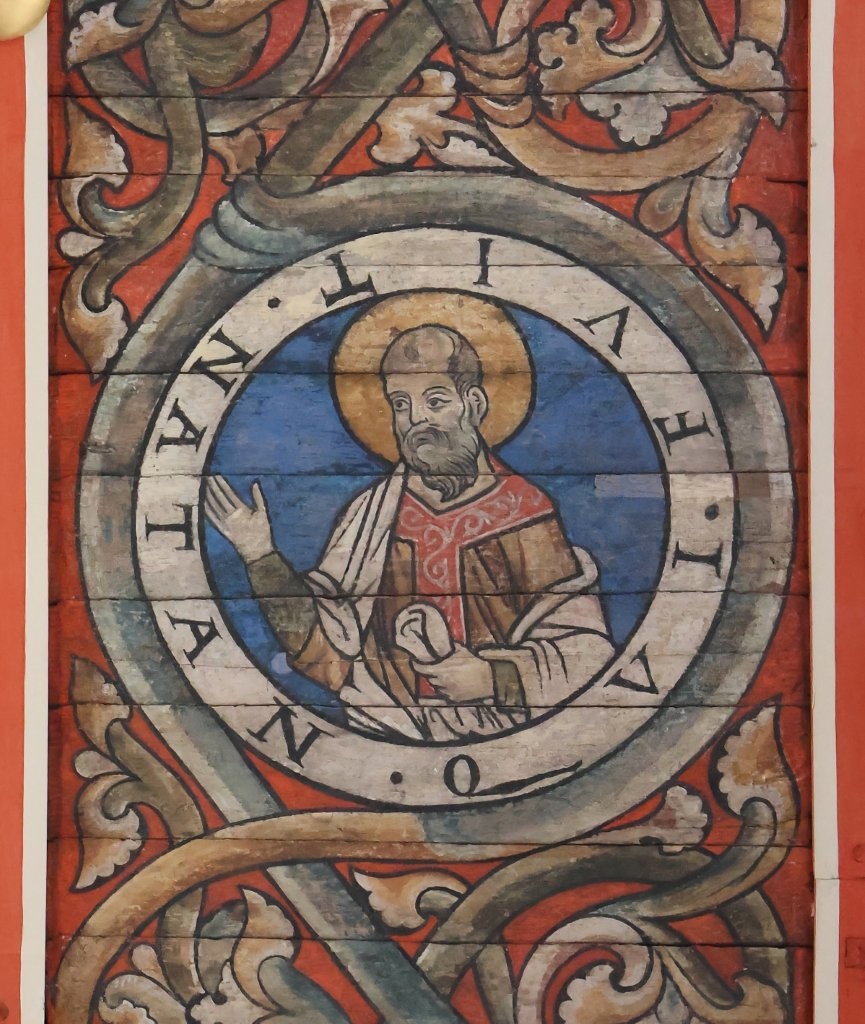
back on the right side, above Obed is Nathan L1 another son of David and halfbrother of King Salomo.

Next, on the left side and two rows lower is Mela L2, great grandson of Nathan

Above Mela is Jona L3 , grandson of Mela (this is not the prophet that is famous for spending 3 days inside a fish)

And above him is Joseph L4 Jona’s son

next above is Juda L5 Son of Joseph

Still on the left side above is Simeon L6 , son of Juda

Above we find Levi L7 , the son of Simeon

Back on the right side, above natan we find Iorim L8 grandson of Levi
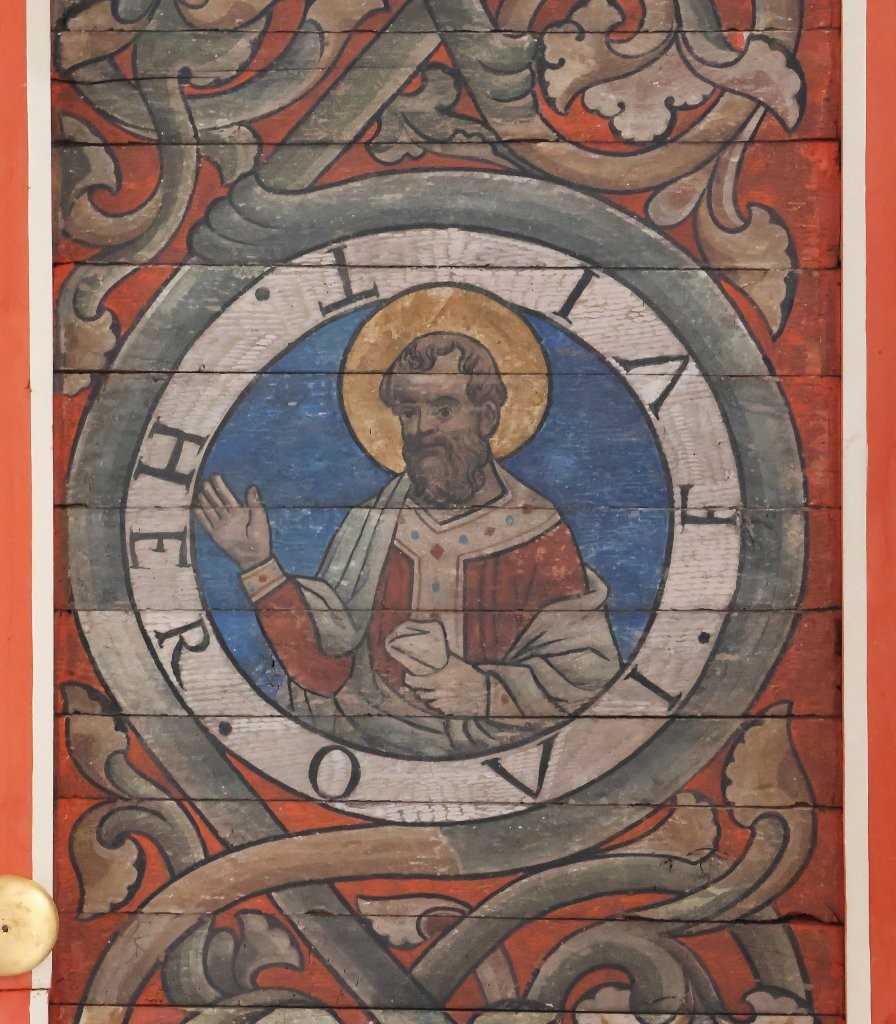
above is Her L9 great grandson of Jorim
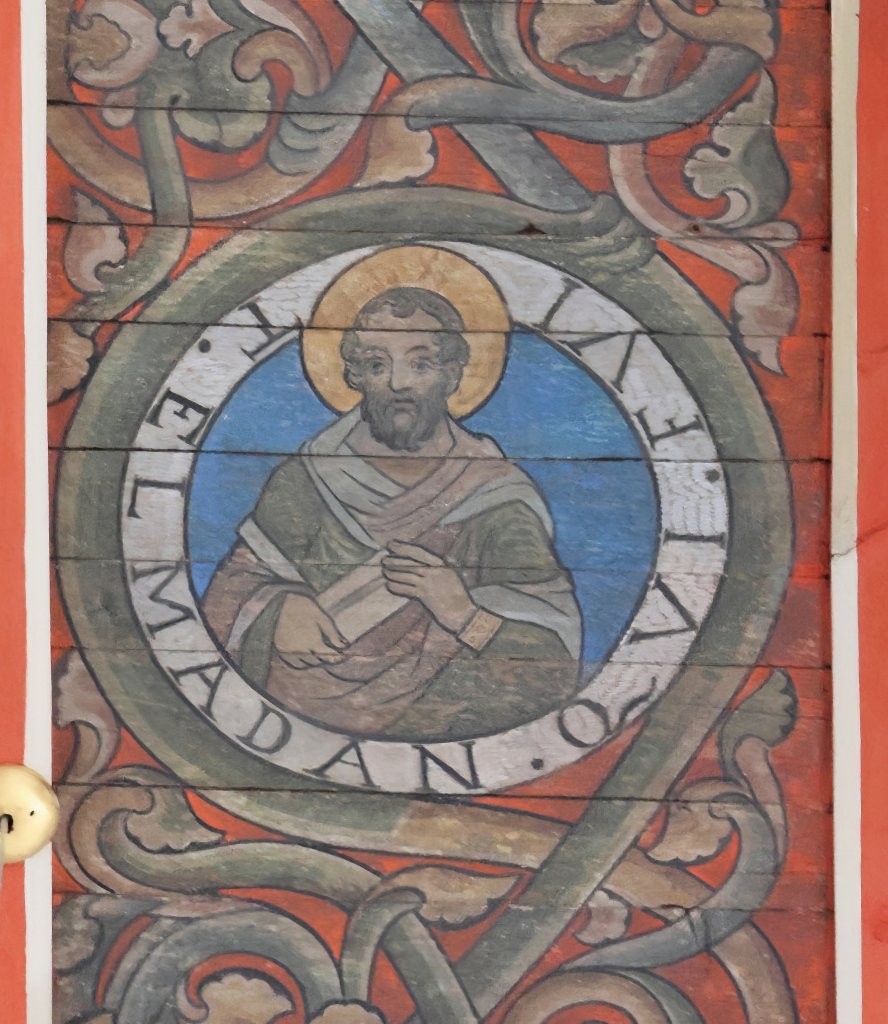
Next on the right side is Elmadan L10 Son of Her

Back on the left is Cosan L11 Son of Elmadan

Addi L12 who is the son of Cosan is back on the right side.

Above we find Melchi L13 Addi’s Son

Meri L14 is back on the left side, the son of Melchi

Above is Rhesa L15 great grandson of Meri

Above him on the left side is Juda L16 grandson of Rhesa

back on the right is Amos L17 he is seven generations down from Juda

back on the left side, the highest on the left side is Joseph L18 , the grandson of Amos, this is not the adoptive father of Jesus.

back on the right side is Ianne L19 son of Joseph

above him is Melchi L20 Son of Ianne

next on the right side of the middle three on the top is Levi L21 son of Melchi

the left of the top three is Mattat L22 Son of Levi

In the middle is Eli L23 Son of Mattat. Eli is the father of Joseph, the adoptive father of Jesus.
Interestingly enough Joseph is not depicted on the ceiling.
From David on: The line of kings (Matthew)
Now back to the middle line which telling more about the list from Matthew. The ceiling shows only a part, namely the kings from David. the ceiling shows four kings in the big medaillons. these are the four that are positively judged in the bible but they also symbolise four cardinal virtues: David courage, Salomo Wisdom, Hizkia Justice and Josiah Moderation.the four virtues also come back around the image of Mary.
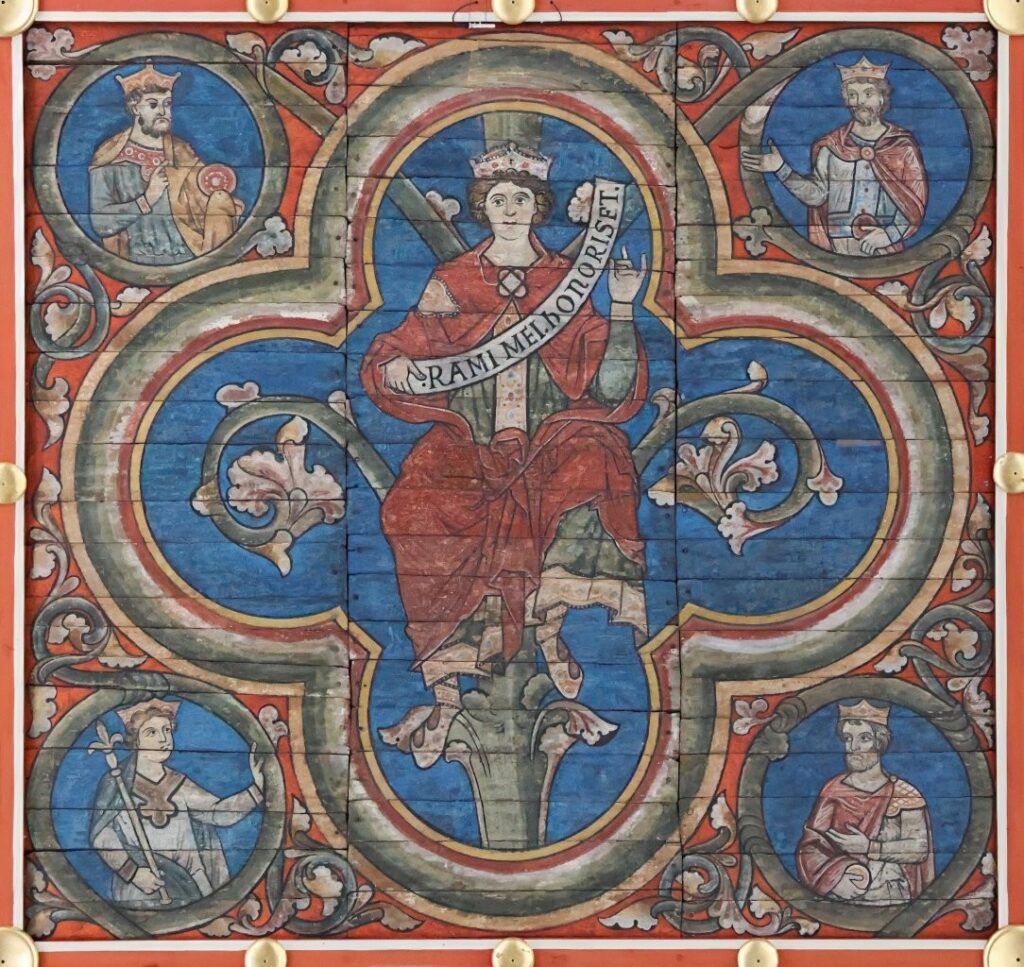
The first is King Salomo M1 famous for his wisdom, he holds the text: rami mei honoris et [gratiae] from the book of Wisdom of Sirach. 24:22 in the vulgate, 24:16 in the modern translations like NCB: [I spread out my branches like a terebinth] and my branches are glorious and graceful. around Salomon are four unnamed kings.

K1 an unnamed King

K2 an unnamed King

K3 an unnamed King

K4 an unnamed King

Next is Hizkia M2 King from 725-697 BC

K5 an unnamed King

K6 an unnamed King

K7 an unnamed King

K8 an unnamed King

Next is Josiah M3 King from 639-609 BC.

K9 an unnamed King
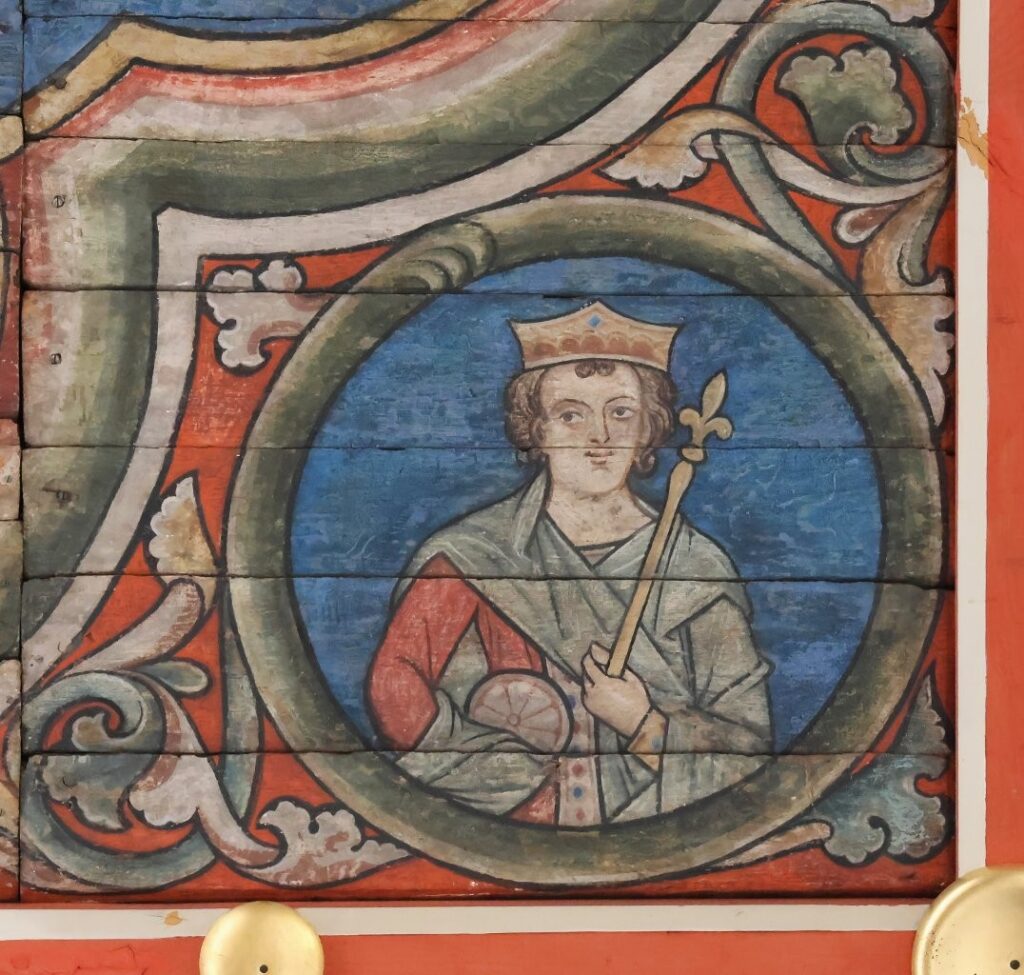
K10 an unnamed King
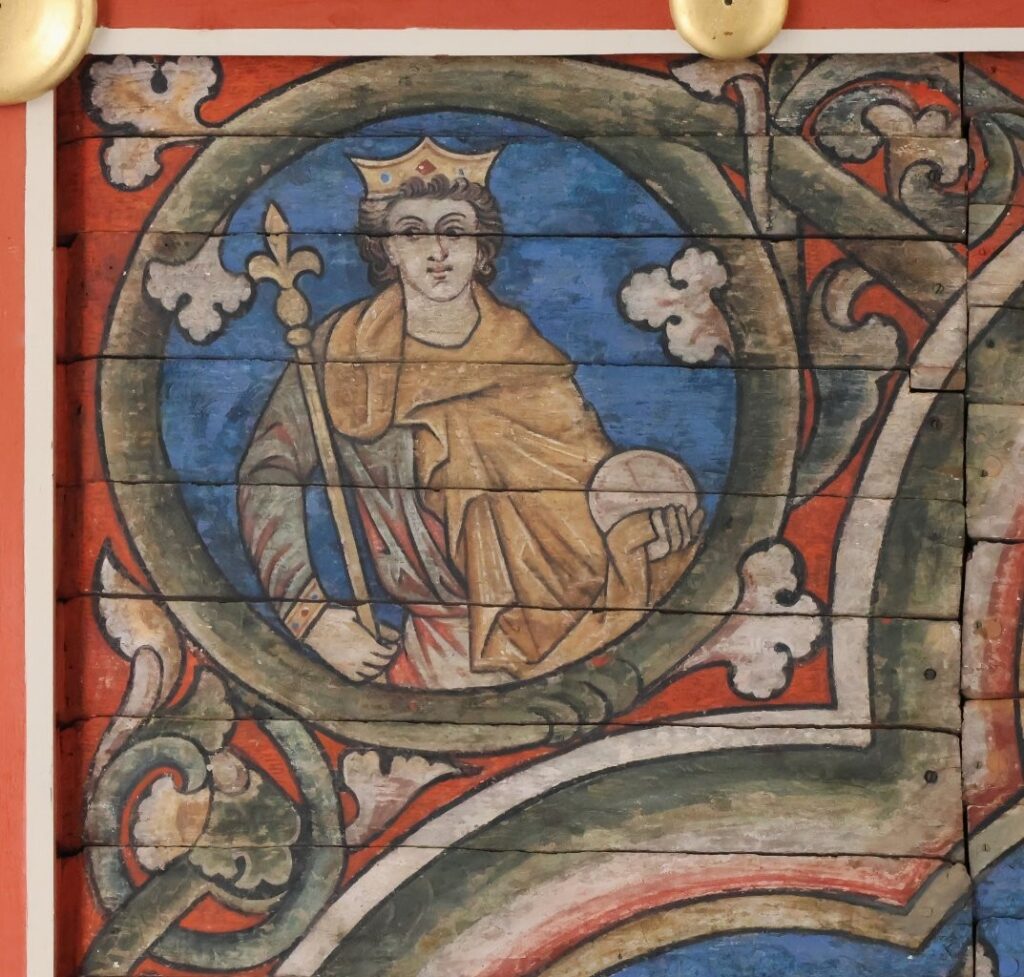
K11 an unnamed King

K12 an unnamed King
Mary

above the kings is the image of Mary M
She is surrounded by four persons representing the four capital virtues

V1 in the bottom left is Moderation, represented by a woman with two jugs

V2 in the bottom right is Prudence, represented by a woman holding a dove and a snake
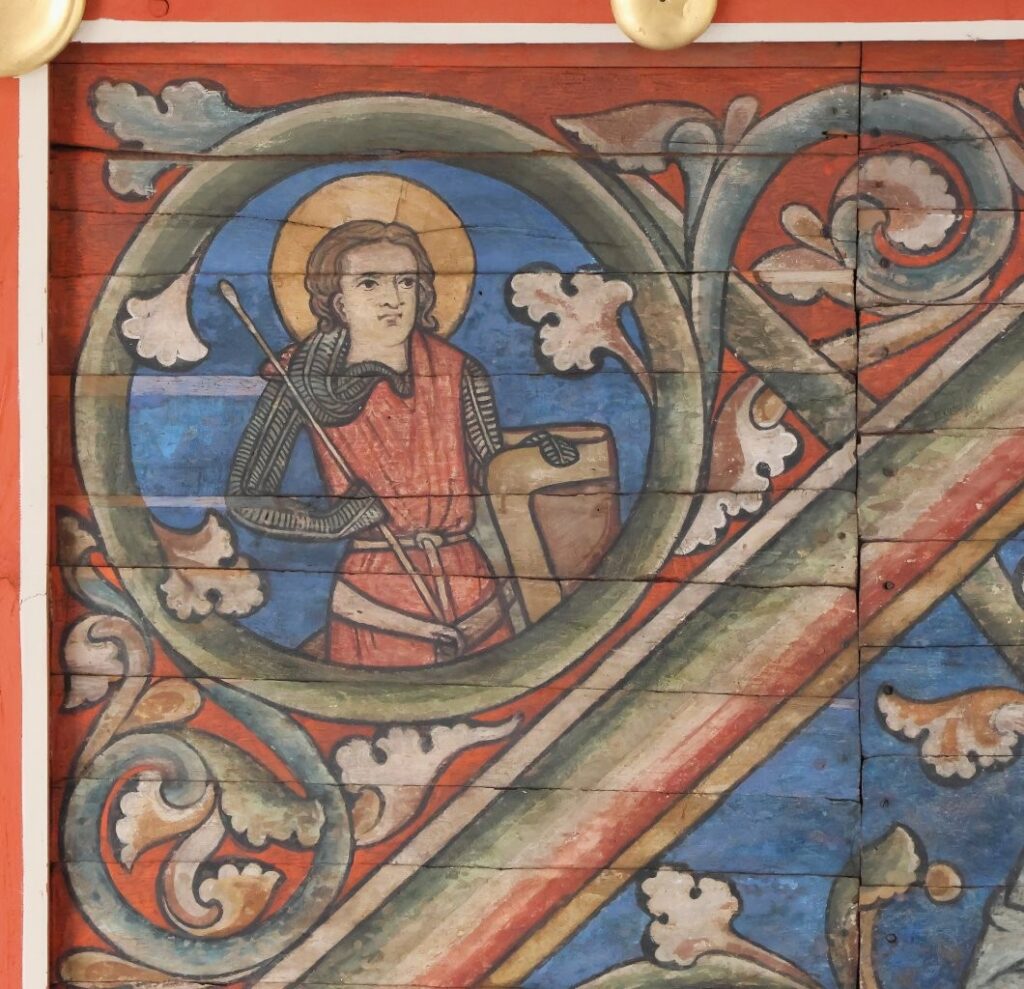
V3 on the top left is braveness, represented as a soldier

V4 On the top right is Justice, represented as a woman with a scale.
Christ Pantocrator and the four archangels
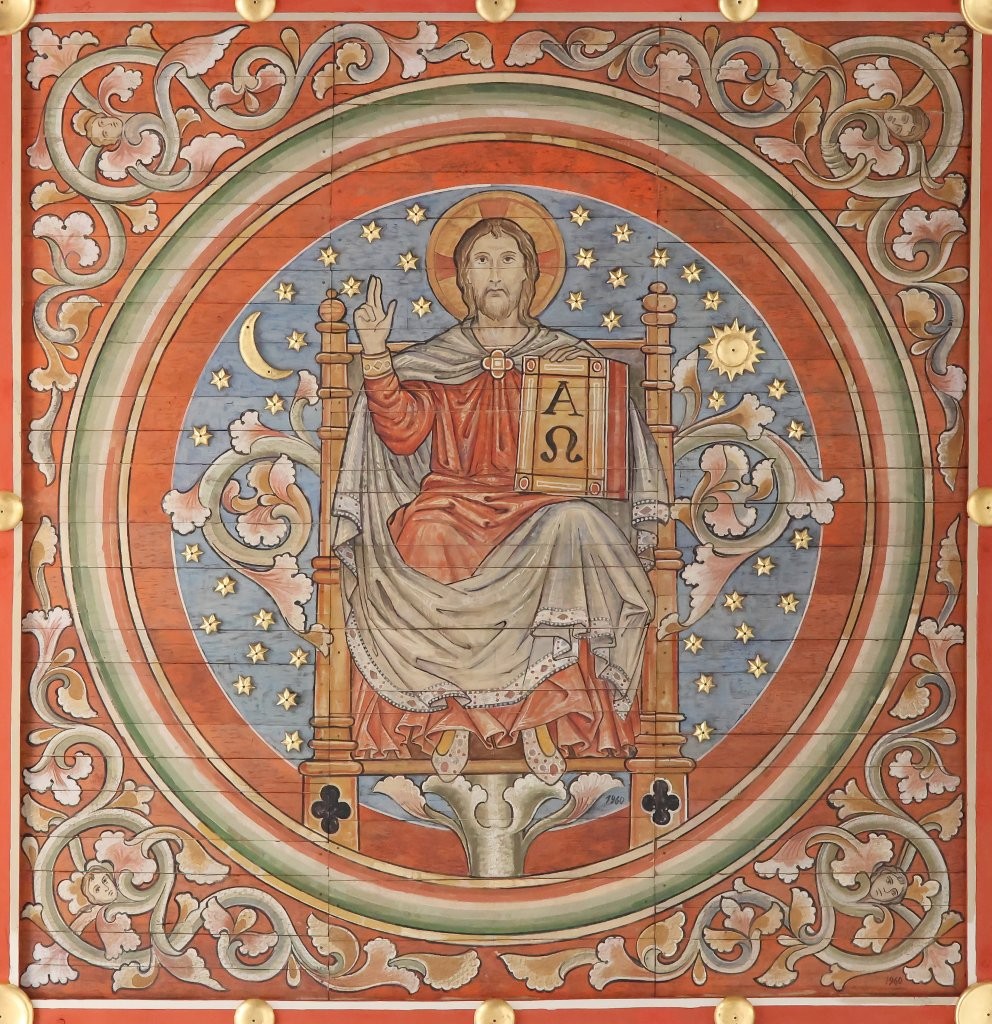
On top, is Christus Pantocrator JC the central figures to which everything leads. He is enthroned as ruler of everything (=pantocrator), with the sun and moon and stars aroudn him, he holds a book with the letters Alpha and Omega, the first and last letters of the alpha, symbolising that christ is the beginning and the end. we also see the branches of the tree of Jesse coming to an end. Around are the 4 archangels. these five are not original anymore, thupper part was destroyed when the east side of the church collapsed and restored in the 17th century, the current ones are replacements after world war II based on the images from 1909.

On the left bottom is the Archangel Gabriel A1

on the lower right is Archangel Michael A2

On the top left is the archangel Raphael A3

On the top right is the Archangel Uriel A4
The prophets and other figures
The last elements are the 24 figures from the old testament, mainly prophets but also other figures foretelling the coming of Christ. the figures are not named but hold a latin text as a clue as to who the person is but after many centuries it is not always easy or even possible. We start at the bottom and go left right upwards.

P1 First we see a figure holding the word: “EGREDIETUR”. This refers to the bibleverse from Isaiah 11:1a -Et egredietur virga de radice Jesse – A shoot will come up from the stump of Jesse. so this is the prophet Isaiah.
This is off course the central verse of the whole ‘tree of Jesse’ idea.

P2 Next on the right side is a person holding the text “orietur.s”. it comes from the book of numbers (24:17): “Orietur stella ex Jacob, et consurget virga de Israel” – “A star comes forth from Jacob, and a scepter rises out of Israel.” The text comes from the heathen seeer Bileam, who at a certain moment blesses the people of Isrel, in which this prophecy of the messih appears.

P3 the next holds the text: ECCE VE[nie(n)t] .D[ie]S, – See, the day comes. It is often the opening of prophecies of Amos or Jeremiah, so it is likely one of these two.
Andreas Lemmel also suggests the possibility this refers to 1 Samuel 16:18, where in a scene where Saul is enraged, someone points to David: “I have seen a son of Jesse from Bethlehem who is talented at playing […]And the Lord is with him” in Latin: Ecce vidi filium Isai Bethlehemitem scientem psallere. [..] et Dominus est cum eo.

P4 on the right we see a person with the scroll “ecce veniet dns exer[cituum]” it is usually attributed to the prophet Malachi “Ecce venit, dicit Dominus exercituum. ” – “Indeed he is coming, says the Lord of hosts.” (Maleachi 3:1)

P5 The next figure holds the text “VINIET . Et. N . TAR” – It comes from the Prophet Habacuc: “exspecta illum, quia veniens veniet, et non tardabit” – “Though it linger, wait for it; it will certainly come and will not delay”. The prophet receives this assurance from God as he keeps on asking when the ancient promises will be fulfilled.

P6 On the right is a person holding the text “I[n] terris vi[sus est]” coming from Baruch 3:38 “Post haec in terris visus est, et cum hominibus conversatus est” -“After that, she appeared on earth and lived with humankind.” The ‘she’ in question here is Wisdom which is a foreshadowing of Christ, secifically the beginning of the gospel of John: “The Word became flesh and made his dwelling among us.” (John 1:14)

P7 The text reads: “VIDI . PORTAM CLAV(sam)” referring to a verse in Ezechiel 44:2 Et dixit Dominus ad me: Porta haec clausa erit: non aperietur, et vir non transibit per eam, quoniam Dominus Deus Israel ingressus est per eam: eritque clausa”
-“The Lord said to me, “This gate is to remain shut. It must not be opened; no one may enter through it. It is to remain shut because the Lord, the God of Israel, has entered through it.” According to Catholic theology, Mary remained virgin for her whole life, so this verse refers to this.

P8 On the right we have Hosea holding the text “V nir o.quasi ymber. n t.” it comes from Hosea 6:3 “et veniet quasi imber nobis temporaneus et serotinus terrae.” – “he will come to us like a shower, like the spring rains that water the earth.”

P9 the next person holds the text: “DESC[e]NDET D[omi]N[u]S” This could refer to the prophet Micha as there is the text in Micah 1:3 “Quia ecce Dominus egredietur de loco suo, et descendet, et calcabit super excelsa terrae.” – “Take note that the Lord is leaving his dwelling place; he comes down and treads upon the heights of the earth.”

P10 on the right is the prophet Joel holding the text “I[n] Monte syon salvat[io]” from chapter 2:32: “omnis qui invocaverit nomen Domini, salvus erit: quia in monte Sion et in Jerusalem erit salvatio” – “And everyone who calls on the name of the Lord will be saved;
for on Mount Zion and in Jerusalem there will be deliverance”

P11 the scroll reads IP[s]E SCIET SPERANTES from the prophet Nahum (Nahum 1.7) “Bonus Dominus, et confortans in die tribulationis, et sciens sperantes in se.” – “The Lord is good, an unfailing refuge in a time of distress. He takes care of those who place their trust in him”

P12 to the right is the prophet Haggai holding the text “Veniet Desiderat[us]” which comes from the verse: “Et movebo omnes gentes, et veniet desideratus cunctis gentibus” – “I will shake all the nations, and the treasures of all the nations will flow in” (Haggai 2:8 Latin-2:7 English).

P13 the next person holds a scroll with the text “VENI.D[omi]NE.VI”, as such the text is not found in any of the prophets, therefore Andreas Lemmel suggests that it links to the prayer of Hizkia (who is depicted next to this figure) when he is attacked by Assyrians (2 Kings 19,16): “aperi, Domine, oculos tuos, et vide” – “open your eyes, Lord, and see”

P14 On the right is a figure holding the text – “Sublevabis” coming from the prohet Jonah 2:7 “et sublevabis de corruptione vitam meam, Domine Deus meus.” – “But you brought me up alive from the pit, O Lord, my God.” from the prayer Jonah made inside the fish to be saved, this fits nicely with the king Hizkai next to him, who was once saved from a deadly disease after prayer and received 15 years of extra life. (2 Kings 20:1-6)
Additional Bible text
2 Kings 20:1 In those days Hezekiah fell ill, and his death was approaching. Isaiah, the son of Amoz, the prophet, came to him and said, “Thus says the Lord: Set your house in order, for you are to die, you will not survive.” 2 Hezekiah turned his face to the wall and prayed, saying, 3 “Please remember, O Lord, how I walked before you in fidelity and with a perfect heart. I have done what was good in your sight.” And Hezekiah wept bitterly.4 The word of the Lord came to Isaiah before he left the middle courtyard, saying, 5 “Return and tell Hezekiah, the leader of my people: Thus says the Lord, the God of David, your father: I have heard, I have seen your tears. I will heal you today, and the day after tomorrow you will go up to the temple of the Lord. 6 I will add fifteen years to your life. I will deliver you and this city out of the hands of the king of Assyria. I will defend this city for my own sake and that of David, my servant.”

P15 The next person holds the text: “Veniet..A” – “He shall come” is often used in old testament prophecies, but the most likely candidate here is Zechariah. in chapetr 9 verse 9 the coming of Jesus to Jerusalem is foreseen: “but Zacharias 9:9 foresees Jesusarrival in Jerusalem “[..] ecce rex tuus veniet tibi justus, et salvator: ipse pauper, etascendens super asinam et super pullum filium asinae.” – “[..} See, your king is coming to you, triumphant and victorious, humble and riding on a donkey, on a colt, the foal of a donkey.”

P16 on the right is a figure holding the text “mitte que” usually attributed to Moses, coming from Exodudus 4:13 “At ille: Obsecro, inquit, Domine, mitte quem missurus es” – “Moses said, “Forgive me, my Lord, but please send someone else” This could be linked to the prayer of Jesus in the garden of olives (“My Father, if it is possible, allow this cup to be taken from me.” Matthew 26:39″). Andreas Lemmel has a different interesting possibility, that it could be Isaiah, who was sent to king Hizkia. in a Vision God asks “quem mittam” – “Whom shall I send?” and Isaiah answers: “Here I am. Send me!” (Isaiah 6:8)

P17 The next one holds IN . VNO . C X (EX?). 0 . S .” full of abbreviations, so hard to interpret. the most likely candidate is Jeremiah it would then be “in uno ex David stirpe’ (someone from David’s house), but that is not found in the biblebook as such. Andreas Lemmel points out a different possibility, being the text “aut UNUM EX prOphetiS.” – “or one of the prophets” from Matthew 16:14. it comes from a passage where Jesus asks his disciples who the people say he is, to which they answer: “Some say John the Baptist; others, Elijah; and still others, Jeremiah or one of the Prophets.” the passage is followed by the question who the disciples think Jesus is, whem Simon Peter replies that Jesus is the Christ. The interpretation does not go through the old testament and is therefore not exactly in line with the other figures being prophets or people from the old testament, but it is pointing to Jesus and his role in salvation.
Bible text:
Matthew 16:13 When Jesus came to the region of Caesarea Philippi, he asked his disciples, “Who do people say that the Son of Man is?” 14 They replied, “Some say John the Baptist; others, Elijah; and still others, Jeremiah or one of the Prophets.” 15 “But you,” he said to them, “who do you say that I am?” 16 Simon Peter replied, “You are the Christ, the Son of the living God.”
From Biblegateway NCB

P18 The figure on the right holds the text “vedies evm” there is a suggestion to Isaiah, but it is impossible to be sure.

P19 The next person holds text ” QUI VENIT” often is attributed to Sophonias, but is not found in the biblebook, Andreas Lemmel suggests it is more likely to come from psalm 117:26 “Benedictus qui venit in nomine Domini” – Blessed is he who comes in the name of the Lord.” (Psalm 118:26). given this figure is located just “before” the image of Mary give this suggestion more weight.

P20 Next is a figure holding the text “Erit r Do” which is attributed to Obadiah: “Et ascendent salvatores in montem Sion judicare montem Esau, et erit Domino regnum.” – “Those who have been saved will ascend Mount Zion to rule over the mountains of Esau, and dominion will belong to the Lord.” (Obadiah 1:21)

P21 Next is a person without a text. Andreas suggest a person of whom no text is recorded or is mute. the first candidate would be Aaron given his priestly clothes, and the fact that Aaron’s rod is seen as a foreshadowing of Mary (as it bloomed). But it could als be Zechariah, the father of John the Baptist (above), who was also a high priest and was struck mute as punishment for his doubts.
Bible texts
Aarons rod: Numbers 17:6-8
Numbers 17:6 Moses spoke to the people of Israel, and all of the leaders gave him one staff each, one for each of the twelve ancestral tribes, and the staff of Aaron was among the other staffs. 7 So Moses placed the staffs before the Lord in the tent of meeting. 8 The next day, Moses went into the tent of meeting. The staff of Aaron of the tribe of Levi had blossomed and brought forth buds. It was blooming and producing almonds.
Zechariah’s Muteness (Luke 1:11-15,18-20)
Luke 1:11 Then there appeared to him the angel of the Lord, standing to the right of the altar of incense. 12 When Zechariah beheld him, he was terrified and overcome with fear. 13 But the angel said to him, “Do not be afraid, Zechariah, for your prayer has been heard. Your wife Elizabeth will bear for you a son, and you shall name him John. 14 He will be a source of joy and delight to you, and many will rejoice at his birth, 15 for he will be great in the sight of the Lord. […] 18 Zechariah said to the angel, “How can I be assured of this? For I am an old man and my wife is well past the stage of giving birth.” 19 The angel replied, “I am Gabriel. I stand in the presence of God, and I have been sent to speak to you and to convey to you this good news. 20 But now, because you did not believe my words, which will be fulfilled at their appointed time, you will lose your power of speech and will become mute until the day that these things take place.”

P22 next we see undoubtedly the Archangel Gabriel with the text “Ave Maria” from Luke 1:28 “Et ingressus angelus ad eam dixit: Ave gratia plena: Dominus tecum: benedicta tu in mulieribus.” – “The angel came to her and said, “Hail, full of grace! The Lord is with you.”

P23 the last one is John the baptist holding the text: “parate viam d[omin]i from the gospel of Matthew 3:3: “Hic est enim, qui dictus est per Isaiam prophetam dicentem: Vox clamantis in deserto: Parate viam Domini; rectas facite semitas ejus.” – “his was the man of whom the prophet Isaiah spoke when he said: “The voice of one crying out in the wilderness: ‘Prepare the way of the Lord, make his paths straight.’”

P24 on the right side, is again Isaiah, this time with “ecce virgo c[oncipiet]” from Isaiah 7:14 “ecce virgo concipiet, et pariet filium, et vocabitur nomen ejus Emmanuel. ” – “The virgin will be with child, and she will give birth to a son, and she will name him Immanuel.”
Sources:
Below are the links to two articles i found on the net with more information on the biblical and theological background which were very helpfull in writing all this, especially the unnamed prophets and old testament figures, if one wants to know more these articles are very interesting, there are also otehr articles on the ceiling from different perspectives.
- Keil, Volkmar: Das theologische Programm der Decke – eine Einführung (German) Article on the digital library of Heidelberg University (link)
- Lemmel, Andreas: Der biblische Hintergrund und Sinngehalt des Deckenbild (German) Article on the digital library of Heidelberg University (link)
All photographs by me and copyrighted, taken on 23rd of September 2025.
Leave a Reply