Stained glass in the Our-Lady-of-Pamele in Oudenaarde: The Tree of Jesse Window (North Window)
The Our Lady of Pamele church (Onze-Lieve-Vrouw van Pamele) is the other church in the city center of Oudenaarde, on the other side of the Scheldt river. it is a smaller early gothic church (built between 1234-1300), it is a church typical for the style of ‘scheldt-gothic’)
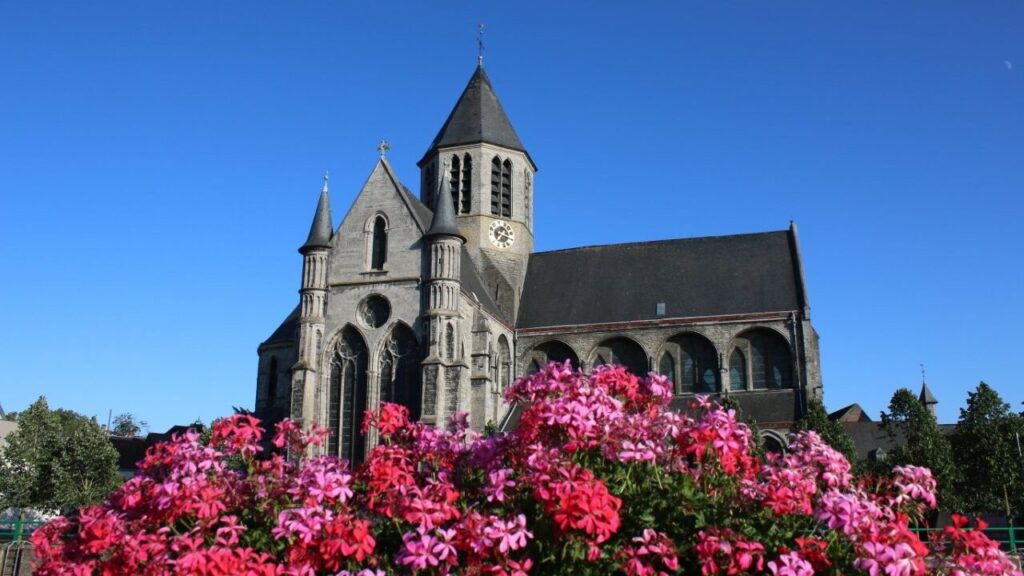
The church is rich in artworks and stained glass, which is too much for one page so it will be over several pages. this page is about the north window, that is the side of the river Scheldt. This window has a theme, namely the tree Jesse.
This window is lso by the same author as the windows in the Saint-Walburga church, Gustave Ladon from Gent. this window was made in 1934.
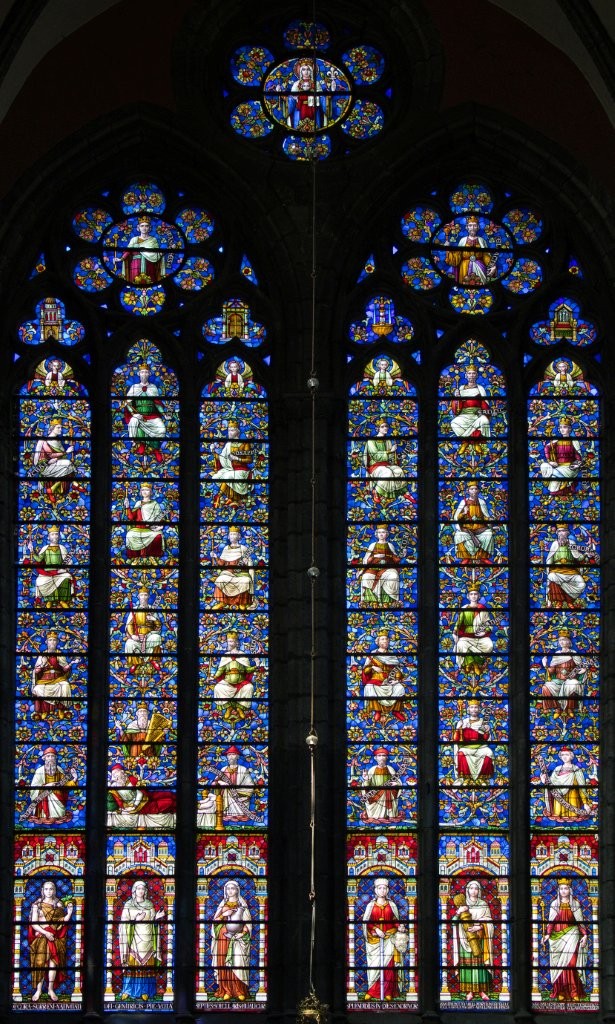
The tree of Jesse is a theme that appears in man stained glasses across churches (for example in Chartres or in the Notre Dame of Paris), and it refers to Jesus being a descendant of King David’s father Jesse. It originates in a prophecy found in the book of Isaiah that is a prophecy of Jesus (Isaiah 11:1) “A shoot will grow out of Jesse’s root stock, a bud will sprout from his roots.”
In this window there is a lot of figures so to make it easier i numbered them in the image below:

Let’s first take look at the main theme, the ‘tree’ itself. numbered in blue.
the lineage usually used for the tree of Jesse windows is the one in Matthew chapter 1, as it contains more kings (there is also one in Luke). the genealogy shows the line from Abraham to David through the Babylonian exile to Joseph. The full lineage as appearing in Matthew is as follows (with added numbers for the ones in the window)
1 This is the record of the genealogy of Jesus Christ, the son of David, the son of Abraham.
2 Abraham was the father of Isaac,
Isaac the father of Jacob,
Jacob the father of Judah and his brothers,
3 Judah the father of Perez
and Zerah (by Tamar),
Perez the father of Hezron,
Hezron the father of Ram,
4 Ram the father of Amminadab,
Amminadab the father of Nahshon,
Nahshon the father of Salmon,
5 Salmon the father of Boaz (by Rahab),
Boaz the father of Obed (by Ruth),
Obed the father of Jesse,
6 and Jesse 0 the father of David the king.
David 1 was the father of Solomon (by the wife of Uriah),
7 Solomon 2 the father of Rehoboam,
Rehoboam 3 the father of Abijah,
Abijah 4 the father of Asa,
8 Asa 5 the father of Jehoshaphat,
Jehoshaphat 6 the father of Joram,
Joram 7 the father of Uzziah,
9 Uzziah 8 the father of Jotham,
Jotham 9 the father of Ahaz,
Ahaz 10 the father of Hezekiah,
10 Hezekiah the father of Manasseh,
Manasseh 11 the father of Amon,
Amon 12 the father of Josiah,
11 and Josiah 13the father of Jeconiah
and his brothers, at the time of
the deportation to Babylon.
12 After the deportation to Babylon,
Jeconiah 14 became the father of Shealtiel,
Shealtiel 15 the father of Zerubbabel,
13 Zerubbabel 16 the father of Abiud,
Abiud 17 the father of Eliakim,
Eliakim 18 the father of Azor,
14 Azor 19 the father of Zadok,
Zadok 20 the father of Achim,
Achim 21 the father of Eliud,
15 Eliud 22 the father of Eleazar,
Eleazar the father of Matthan,
Matthan the father of Jacob,
16 and Jacob the father of Joseph,
the husband of Mary, by whom Jesus was born,
who is called Christ.
now let’s take a closer look at each of the figures, all of them are surrounded by flowers and branch motives.

The first is Jesse ( 0 ), the root of the tree. who is (as usual) shown asleep, and we see a branch growing from him.

the first king is not named, and is just above Jesse, but is easily identifiable as David ( 1 ), as he is depicted with a harp, as a good number of psalms are attributed to him.
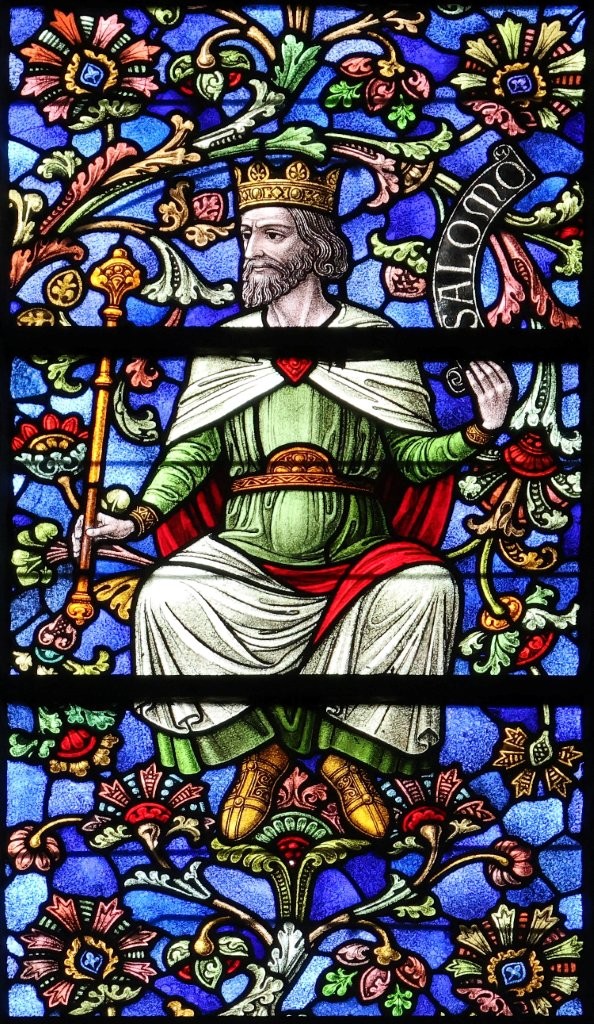
from now on all are identified with their names, the next one being Solomon (Salomo in latin) ( 2 ), on the top right of David. He was the son of David and mostly known as a wise ruler (a Solomon’s judgment) and builder of the temple.

Next is Roboam ( 3 ) just above Solomon, a son of Solomon, and was the first king of the kingdom of Judah, after the split.

Next is abijah ( 4 ), 2nd King of Judah. son of Roboam, and to the left and down from his father.

to his left down, is Asa ( 5 )

back to the middle column is Asa’s Son Josaphat ( 6 )
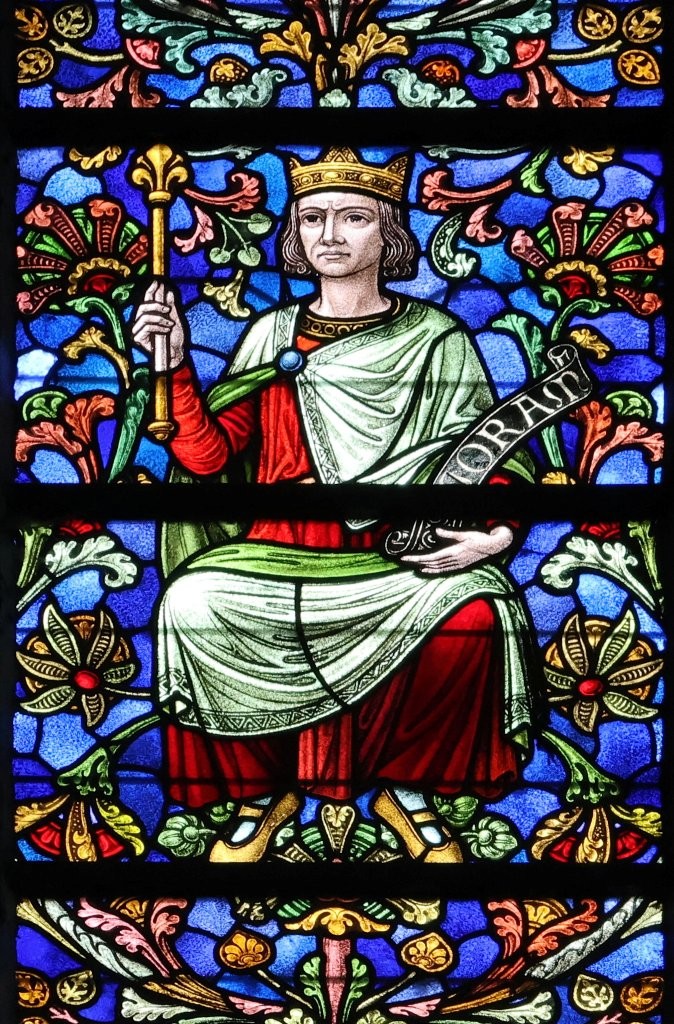
to his left under is Joram ( 7 )
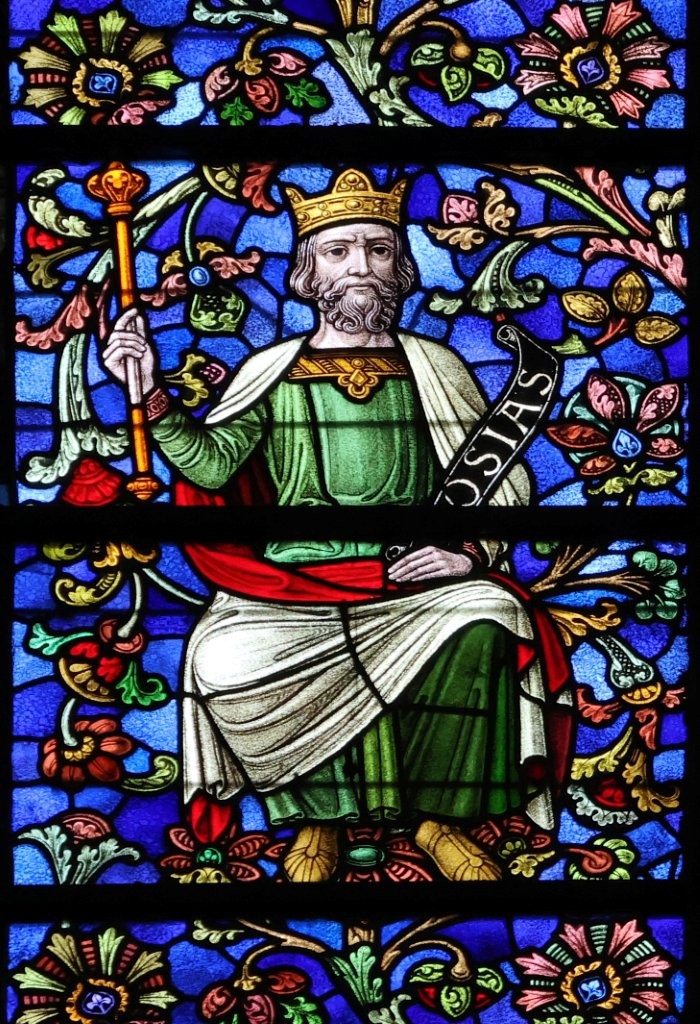
to his left under is Uzziah ( 8 )

Back again on top is is Joatham ( 9 )
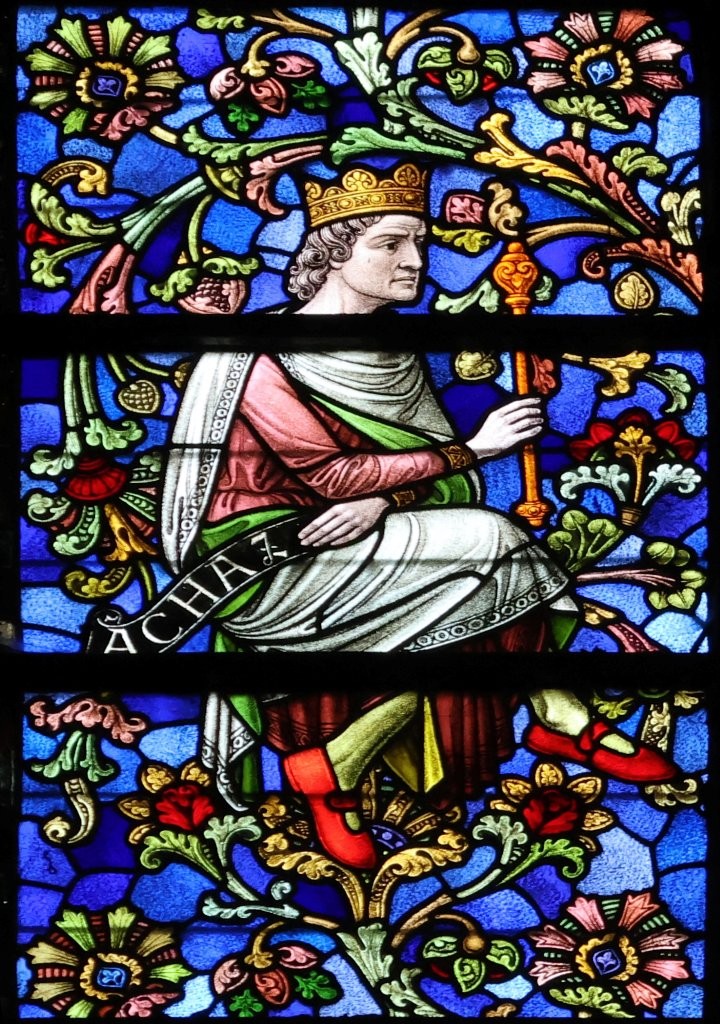
to the left under is Achaz ( 10 )

next on top in the little rosette window is Manasse ( 11 ), here they skipped a generation.

in the middle of the right window back on the bottom is Manasses son Amon ( 12 )
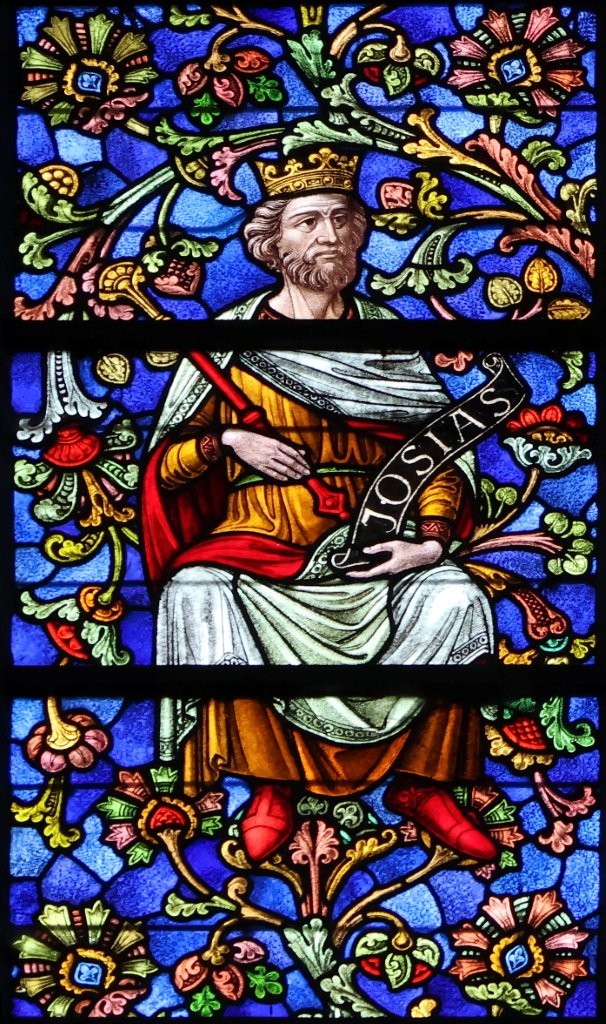
to his left on top is his son Josiah ( 13 )

going to the right is the next generation Jeconiah ( 14 )
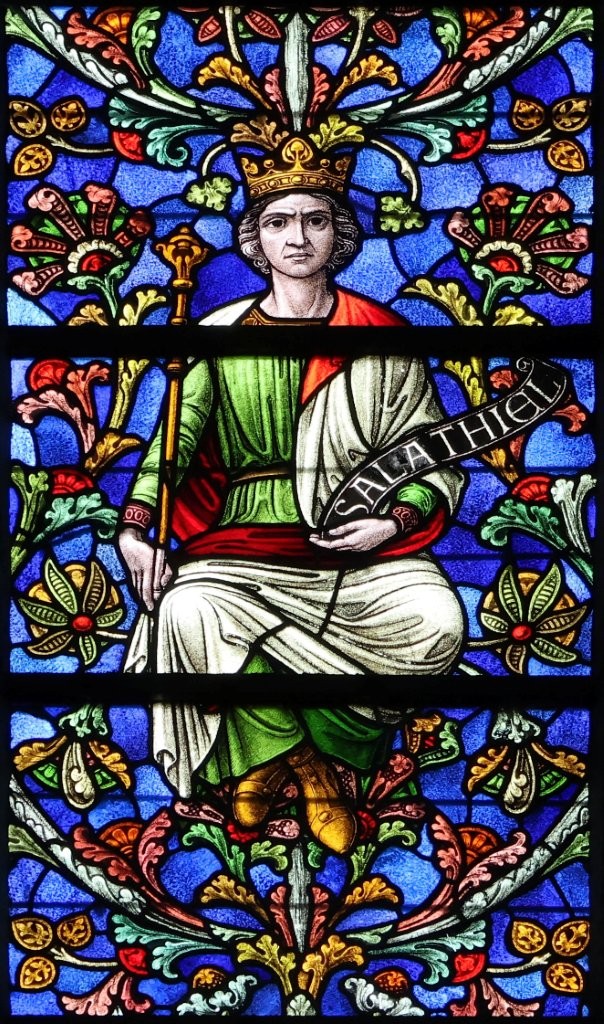
to the top left is Jeconiah’s son Shealtiel ( 15 )

to Shealtiel’s top right is His Son Zorobabel ( 16 )
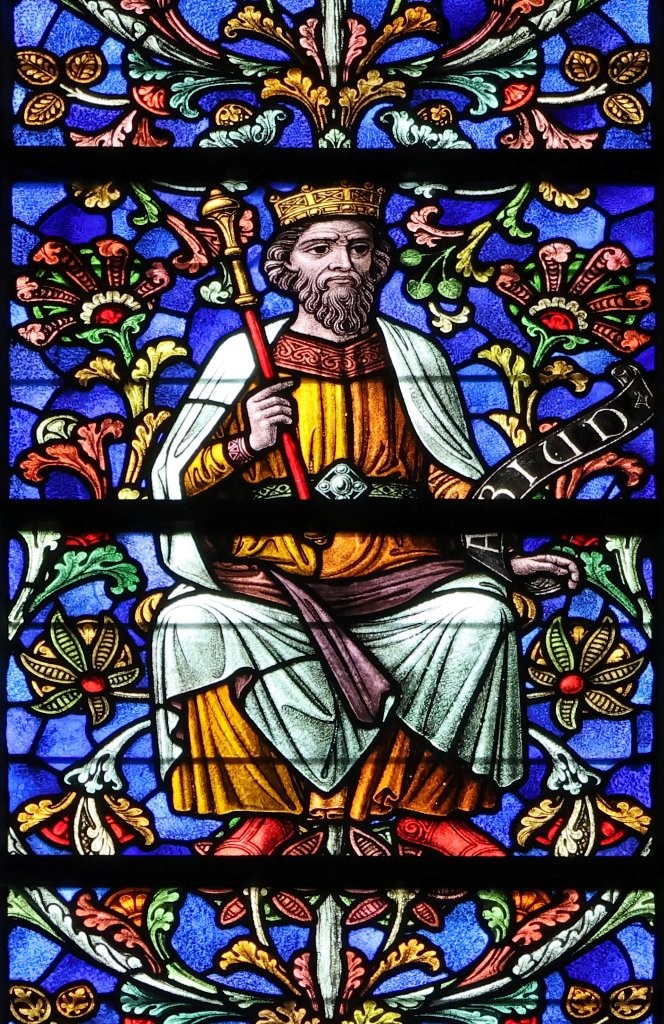
to the top left, next is Abiud ( 17 )

strangely enough for the next generation it jumps up to the little window on the top, Eliakim ( 18 )

going back down, there is Eliakim’s son Azor ( 19 )

again jumping up is Zadok ( 20 ) , Azor’s son

next, down to the left is Achim ( 21 ), Zadok’s son

to Achim’s right is the last of the kings shown, Achim’s son Eliud ( 22 )
The whole genealogy leads to Mary, going more to the top, first with 4 small windows showing symbols representing titles given to mary, accompanied by an angel, from left to right:

The first Title ( 1 )is one appearing in the Litany of Loreto
Mary. David’s Tower

next ( 2 )is one also appearing in the Litany of Loreto
Mary. Gate of heaven
this one ( 3 ) is not appearing in the Litany of Loreto, and i am not entirely sure, but there seems to be a title:
Mary, fountain of salvation

the last one( 4 ) is again from the Litany of Loreto:
Mary, Seat of Wisdom

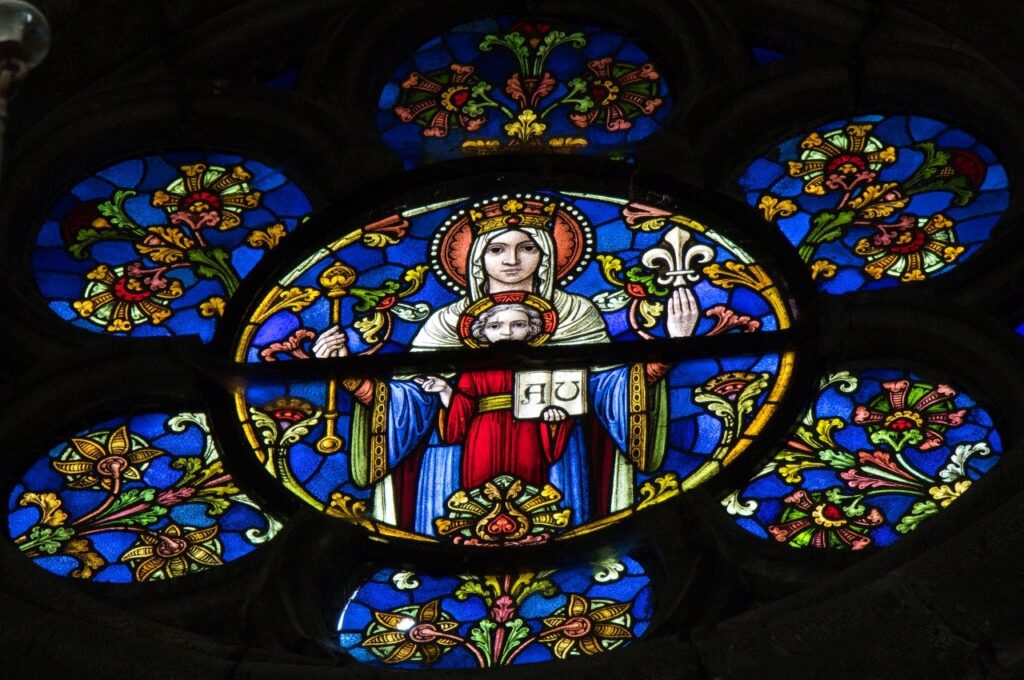
centrally on top is Mary showing Jesus in the middle of a small rose window
this leaves the figures on the same level of Jesse and the 6 women below.
the 4 figures next to Jesse are 4 prophets, who they are is hinted by the text they are holding
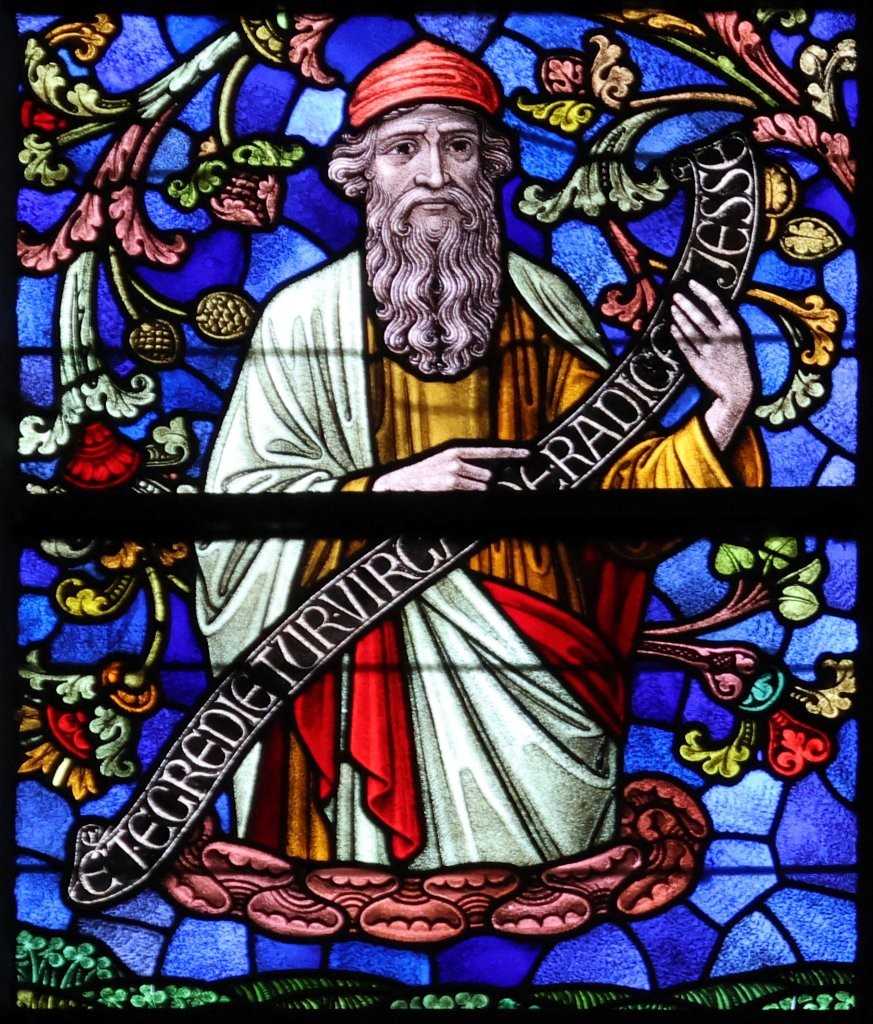
on the left is Isaiah 1 holding the text in Latin: “Et Egredietur virga de radice Jesse” – “A shoot shall come forth from the root of Jesse” (Isaiah 11:1), the base text for the idea of the “tree of Jesse”. it is of course not a coincidence that the word ‘virga’, meaning shoot or branch, only differs one letter from the word ‘virgo’ or virgin, referring to the vrigin Mary

next is the prohet Jeremiah 2, holding the text “Revertere, virgo Israel, revertere ad civitates tua” – “Return, O virgin Israel, return to your cities.” (Jeremiah 32:21). a part from a prophecy hopefull of return from the Babylonian exile.
Next is the prophet Ezechiel 3 holding the text “Porta Clausa Erit” – The gate will remain shut” (Ezechiel 44:2).

last is the prophet Daniel 4 holding the text “abscissus est lapis de monte sine manibus” – “a rock was cut from a mountain, but not by human hands” (Daniel 2:34)

At the bottom are the figures of 6 women, from the old testament

the first is Eve ( 1 ), Mary is often named as the ‘new Eve’

Second is Sarah ( 2 ), The wife of Abraham. Her Story has similarities with Mary, as both had an angel visiting, telling them they would become pregnant, both questioned this, and off course Sarah’s son isaac was (almost) sacrificed by Abraham, a story often linked to the sacrifice of Jesus for mankind.

The third is Deborah ( 3 ), the prophetess from the book of Judges, she prefigures Mary, as Deborah helped in liberating Israel from opression from Canaan.
Next is Judith ( 4 ) , who decapitated Holofernes, and so on her own was instrumental in saving Israel. This is also similar to Mary.

Next is Ruth ( 5 ). a figure that was very devoted to God and humble, just as Mary.
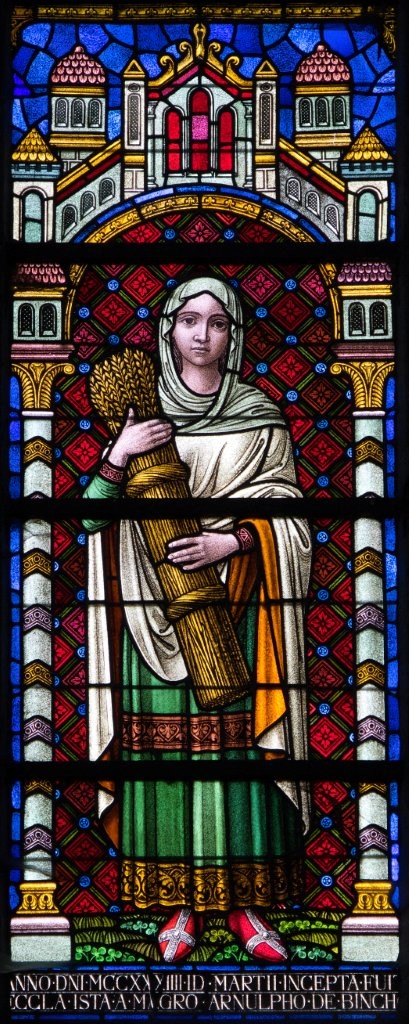
Last is queen Esther ( 6 ). she saved Israel from annihilation through her intercession and actions, just as Mary in catholic tradition is seen as intercessing for humankind as the queen of heaven….

on the bottom spread over the 6 windows is the following text:
“Decora surrexi nativitati dei genitricis pie vota septies soecularis filiali cura splendidus in dies exornor. anno d(omi)ni mccxxxii id(us) martii incepta fuit eccl(esi)a ista a mag(ist)ro Arnulpho de Bincha anno d(omi)ni mcmxxxiv hanc fenestram pinxit magister G Ladon Ganda” – or translated*:
I rose in beauty for the Nativity of the Mother of God, a pious offering of the seventh centenary, splendidly adorned day by day with filial care.
In the year of our Lord 1232, on the Ides of March, this church was begun by Master Arnulf of Binche.
In the year of our Lord 1934, this window was painted by Master G. Ladon of Ghent.
*translated by google translate and chatGPT, as i don’t master latin, i’m open to corrections
Source
Inventaris van Het kunstpatrimonium van Oost-Vlaanderen – De Onze-Lieve-Vrouwkerk van Pamele te Oudenaarde II.Kunstwerken, Lic. Rosa Van Den Abeele-Bellon, Gent, 1979. (NL)
All pictures taken by me and copyrighted, on 17 May 2025
Leave a Reply