The windows of Gniezno Cathedral: Saint Wojciech
Gniezno. The city is not a metropole, the city center is small….. but the city is huge for Poland and it’s history. Poland has a 1000 year history, and it all started in Gniezno (or the area around it).
in the tenth century AD in the area of nowadays central Poland there were several slavonic tribes, of which the Polans grew to be one of the strongest. In 966 the leader of this tribe decided to become Christian and was baptised (the most likely place being the fortified island in the lake of Ostrow Lednicki 16km west of Gniezno. The tribe would continue to grow and be the founders of Poland, the baptism became known as the baptism of Poland and is also regarded as the start of the long and rich history of Poland. Gniezno became its first capital and first bishopric. In 1039 the capital was moved to Kraków, but the bishop of Gniezno is still seen as the leader of the Polish catholic church.

The importance of Gniezno within the catholic church is also because of another figure. Swięty Wojciech. His name is often translated as Saint Adalbert. The translation is far from ideal but is common in english
The cathedral’s full name is the Primatial Cathedral Basilica of the Assumption of the Blessed Virgin Mary and Shrine of St. Adalbert. one of the central elements of the choir is the reliquary of the saint, that is the patron saint of Poland.


another famous element of the cathedral are the ‘gniezno doors’ , a 12th century set of 2 3 meter high bronze doors depicting the life of Saint Adalbert. (good topic for a different page in the future).
The cathedral has beautifull stained glass, but they are high up, so they are not so greatly visible but still worth seeing. They were created by a polish woman stained glass artist: Maria Powalisz-Bardońska (1935-2021), at the end of the 80’s and beginning of the 90’s. the first set is in the nave of the church, telling the story of Saint Adalberts life, death and after. the second set is in the choir and links more to historical events.
The life of Saint Adalbert
The windows start at the back of the church on the right side, go to the front and then back on the left side.
Saint Adalbert was born around 956 in Gord Libice in current day Czech Republic, he was baptised, which is the first window:

For further studies he was send to Magdeburg (the second scene)

in 981 he was chosen to become the bishop of Prague. in the next scene, the saint receives the bishop’s staff from the emperor Otto II

in 988 he was forced to flee, after his family came into conflict with the duke of Poland. He went to Rome to a monastery on the Aventine hill where according to legend a miracle took place, Saint adalbert dropped a jug, but picked it up unbroken.

in 992, the bishop of Mainz (who was his superior) demanded Adalbert to return to his bishopric in Prague, but after more troubles he ended op in the court of Boleslaw Chrobry (the Brave) in Gniezno
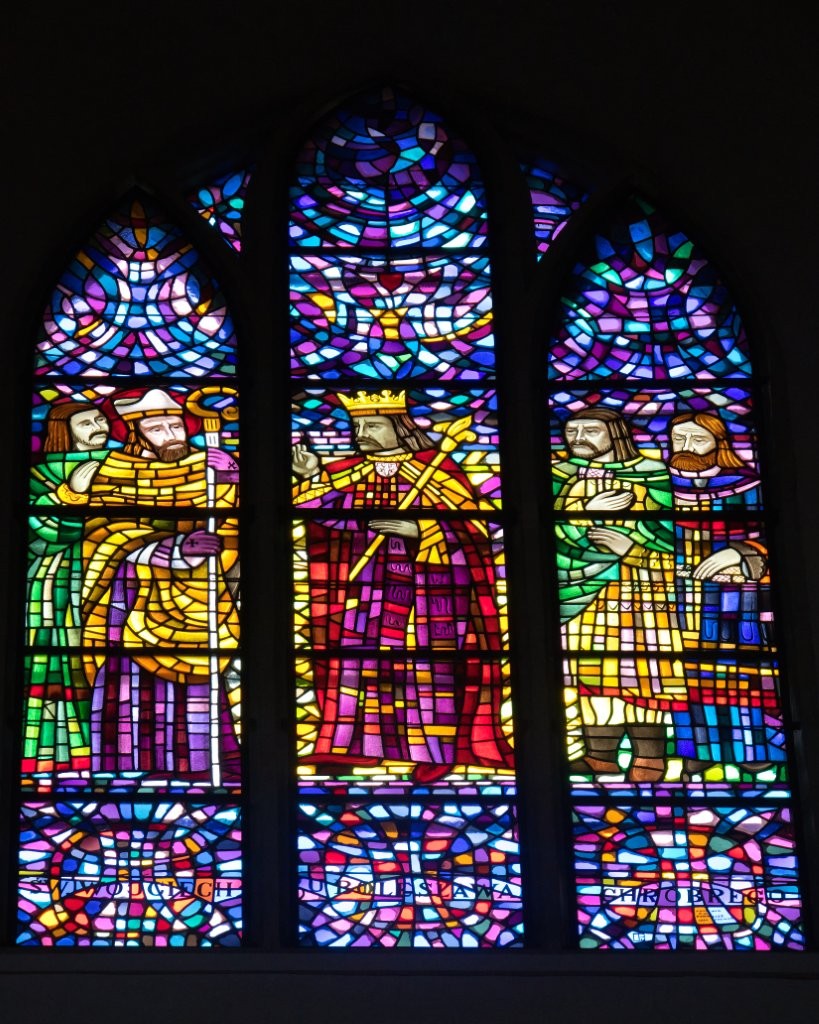
from there he went on to go on a mission to spread the gospel in Prussia

On the 23rd of April 997 he was murdered in Prussia.

the next window shows a white eagle (a symbol of Poland) waking at the site where the body of Saint Adalbert lies.

Later duke Boleslaus bought the body of Saint Adalbert, paying the weight of the saint in gold.
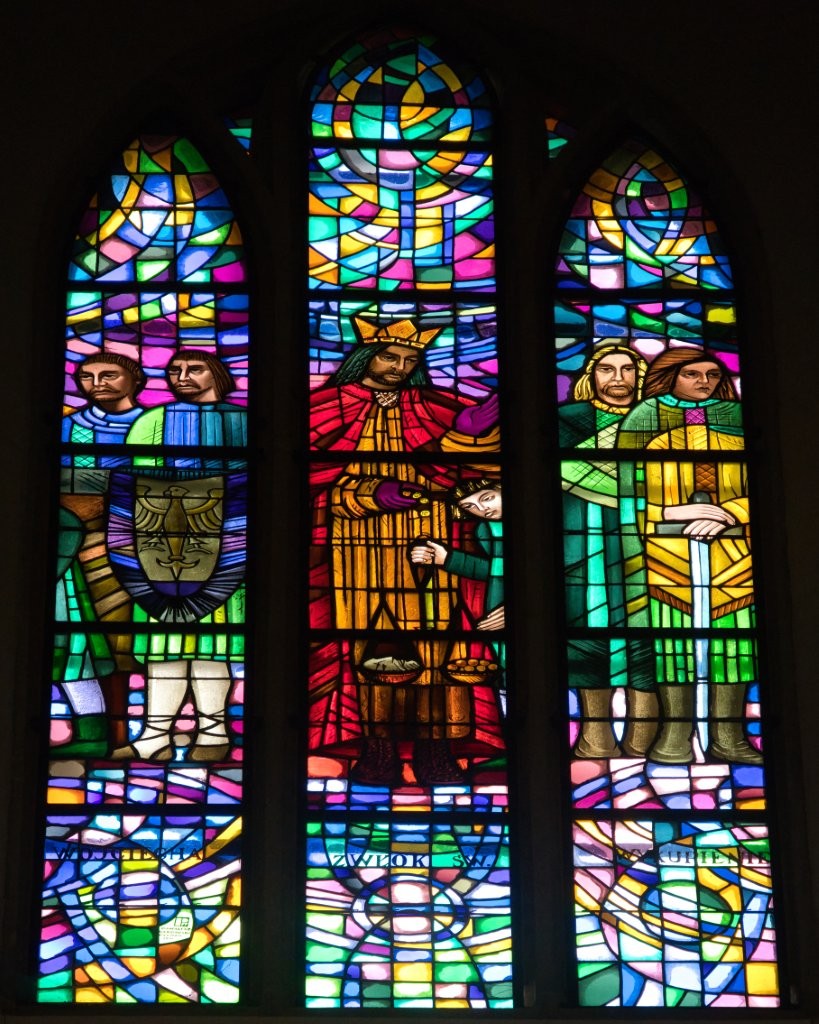
the last window shows the entombment of Saint Adalbert in Gniezno.

The windows in the choir
The choir shows centrally a window with Mary and Jesus, sided by angels and flowers, and windows linked to events and persons linked to Gniezno and Saint Adalbert. so we will look at these from the fron t to the back.
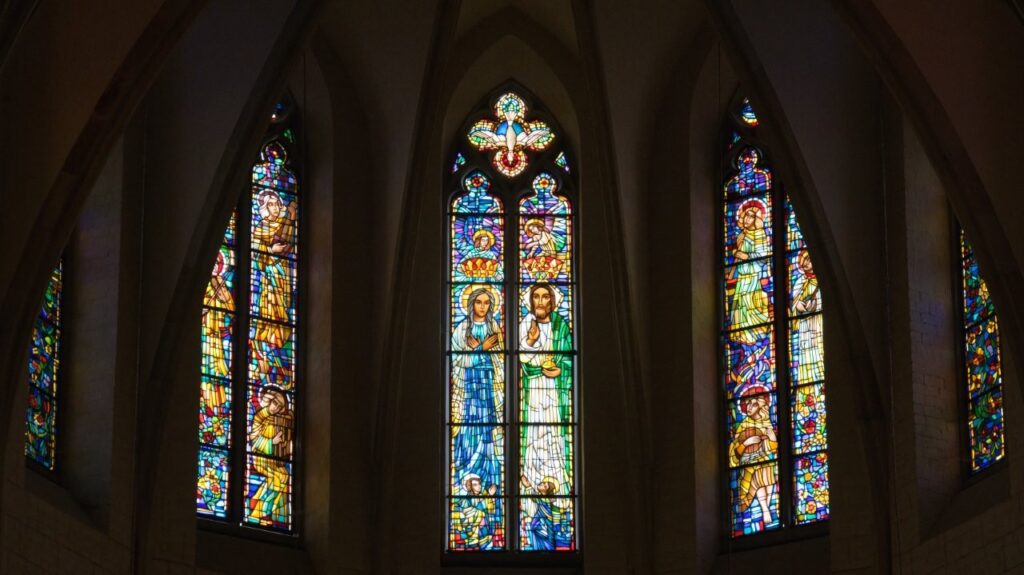
The central window shows Jesus and Mary, crowned by angels, with a dove (symbolising the holy spirit) on top

on both sides are windows with angels making music


next to that are two windows with flower motives


Next on the left is a window remembering the pilgrimage of emperor Otto III in Gniezno (in the year 1000, known as the congress of Gniezno). we see the emperor in the middle and flanked by Boleslaus and a bishop. on the right is the coronation of Boleslaus as King of Poland (in 1025).


next are 2 scenes of which i’m not sure, but seem to be Saint Adalbert.
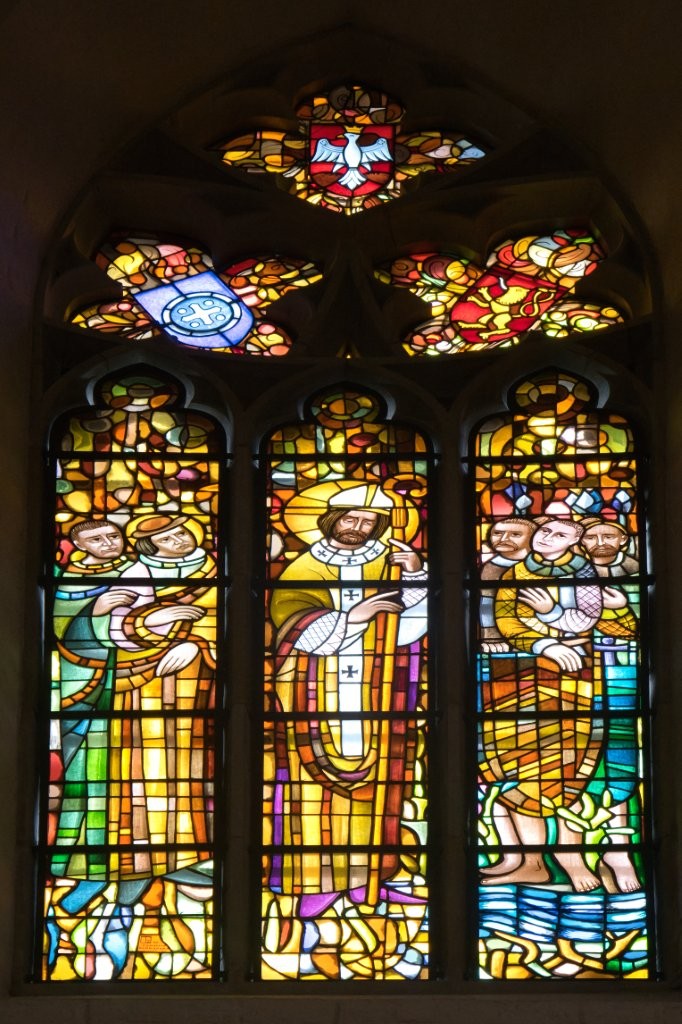

in the next two windows we see on the left we see a window remembering the baptism of duke Mieszko I in 966. on the right side we see the blessed Yolanda, who was the daughter of the Hungarian king and married a Polish prince in the 13th century, after her husband’s dead she became a nun.


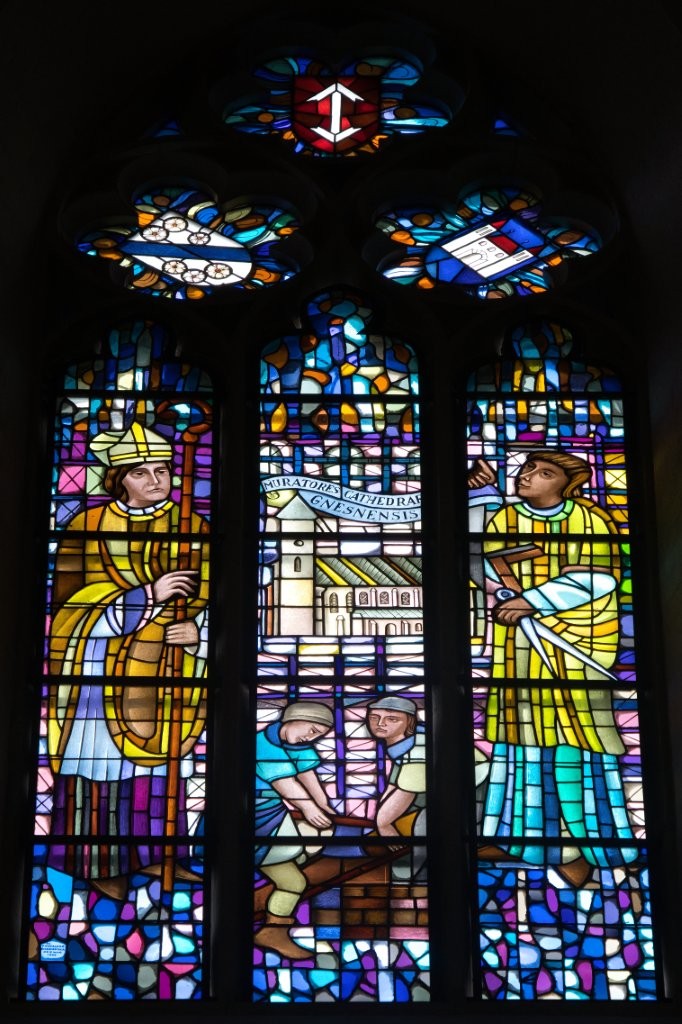
the last two show on the right a hommage to the builders of the cathedral and on the left is Rzepicha. the legendary great-great grandmother of Polands first historical ruler Mieszko. Het husband was Piast, the founder of the piast dynasty of which also Boleslaus was part of.

All pictures (copyrighted) taken by me on 17 July 2025.
Links
- more info on Maria Powalisz Bardonska (PL)
- for a wirtual walk in the cathedral andd other parts of Gniezno here
- More info on saints:
- more on historical events and figures
- congress of gniezno (1000)
- the christianisation of Poland (the baptism of Poland) (966)
- Duke Mieszko I
- Duke/King Boleslaus I
- the semi legendary Rzepicha
Leave a Reply