The Mary Window of the Sint-Eligiuskerk in Eine (Oudenaarde, Belgium)
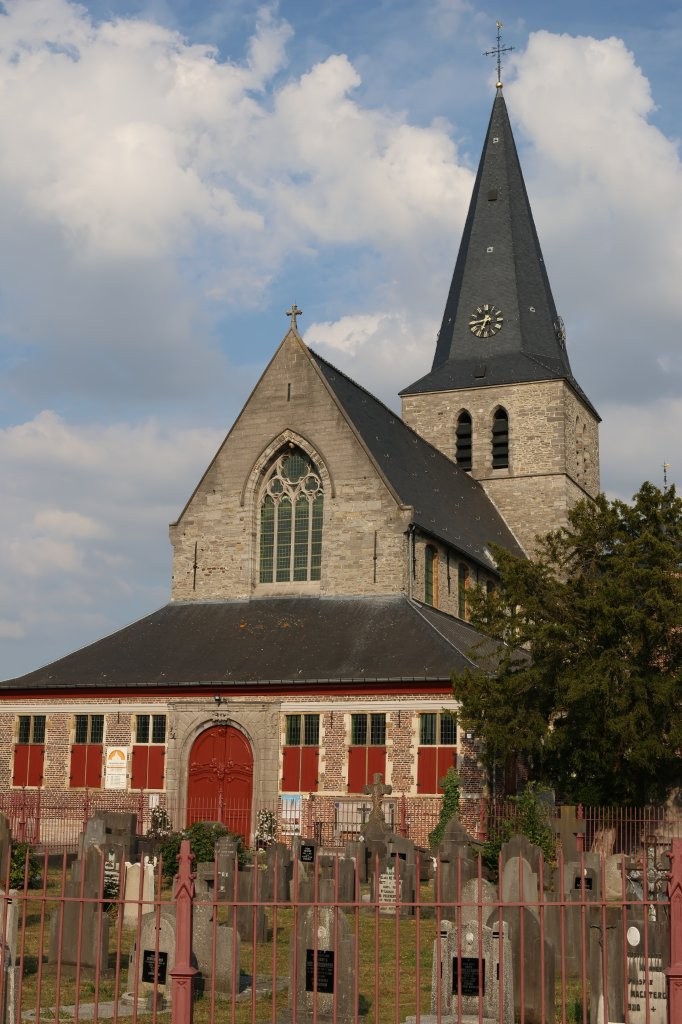
Eine is nowadays a suburb of Oudenaarde, but the small village has a rich history. The first mention of Eine in written documents dates from 1068, and the village had a lord with a castle. The church is late romanesque style, and a foundation date is hard to put, but the church is probably around a thousand years old. it also has been renovated and changed later on, as the church was burnt during the religious wars in 1578, and also heavily damaged at the end of the first world war, so the romanesque style is not always so visible.
This is the church from outside
In this article we will look at the stained glass window in the chapel of the counts of Landast at the left side of the choir.
unfortunately I was not able to find any sources on who the author of the window is, or the exact year of production, so I will give my interpretation of this window, and the plan behind it.
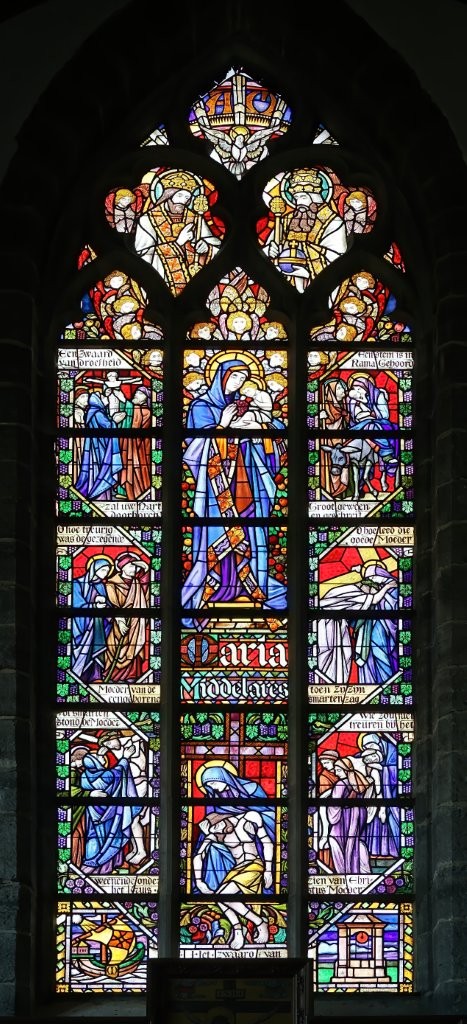
First, let’s look at the total window
And now in more detail, we begin on top.
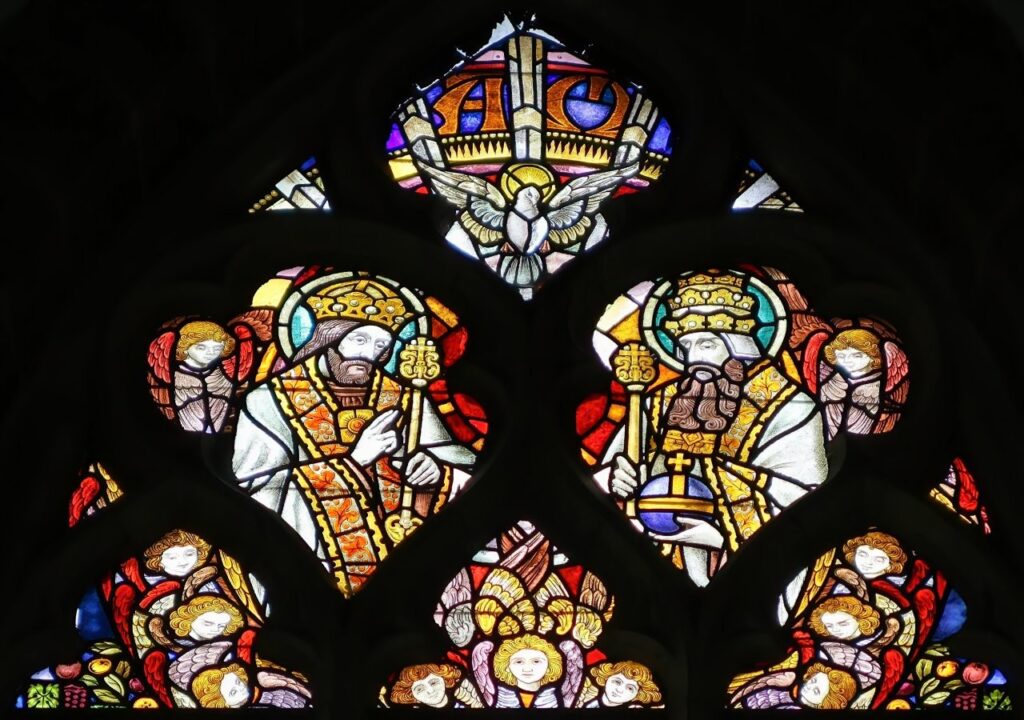
here we see a number of angels and the Trinity
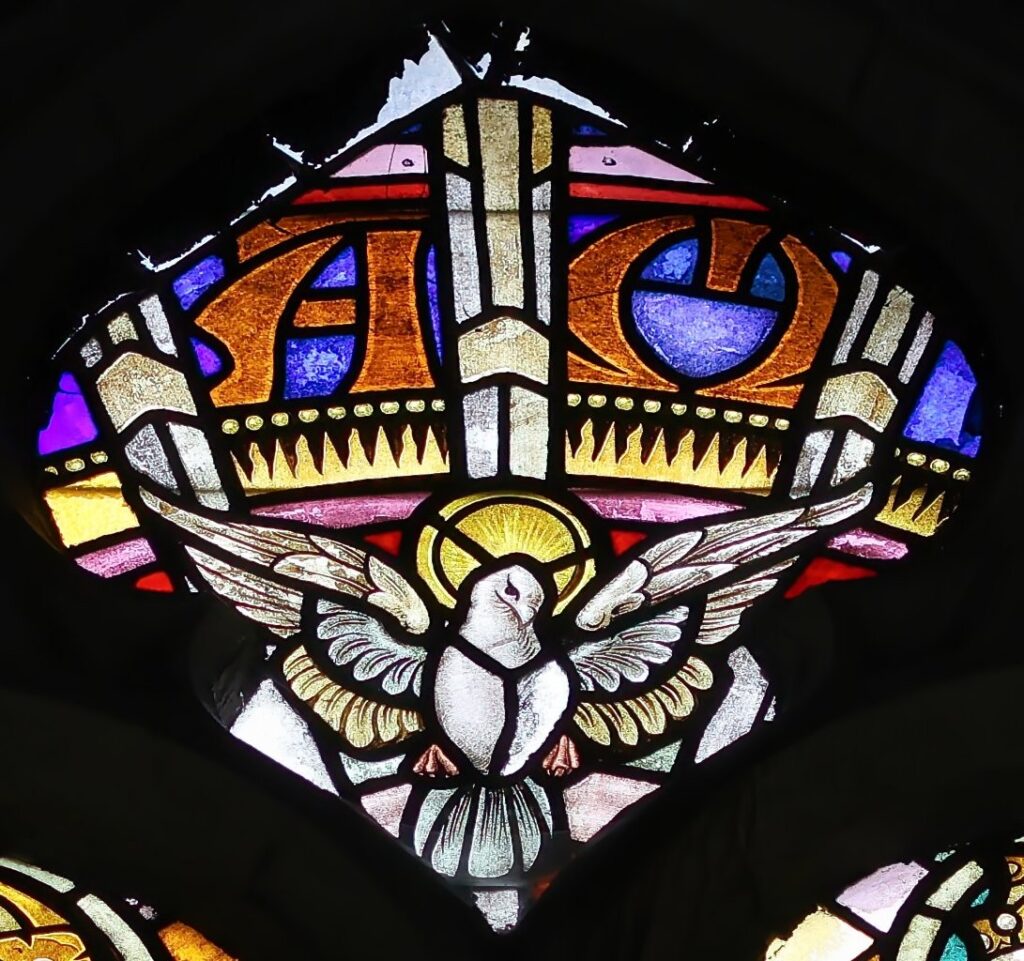
On top we see a dove, symbol of the holy spirit, with above the Greek letters alpha and omega, the beginning and the end of the Greek alphabet and often used as a symbol that God is everything. this symbol is mentioned in the book of Revelation
Bible text (Revelation 1:8)
8: “I am the Alpha and the Omega,” says the Lord God, “the one who is, and who was, and who is to come, the Almighty.”
From Biblegateway NCB
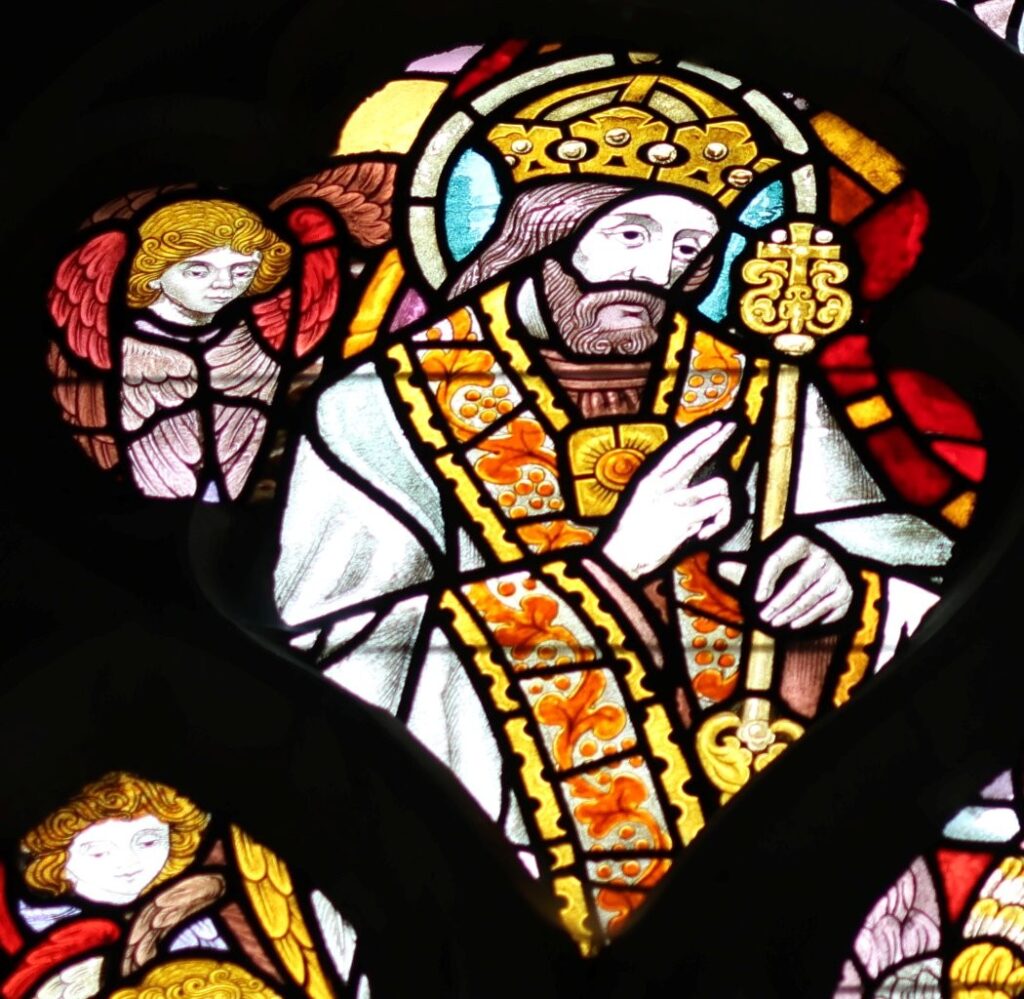
on the left we see a young king, symbolising God the Son: Jesus
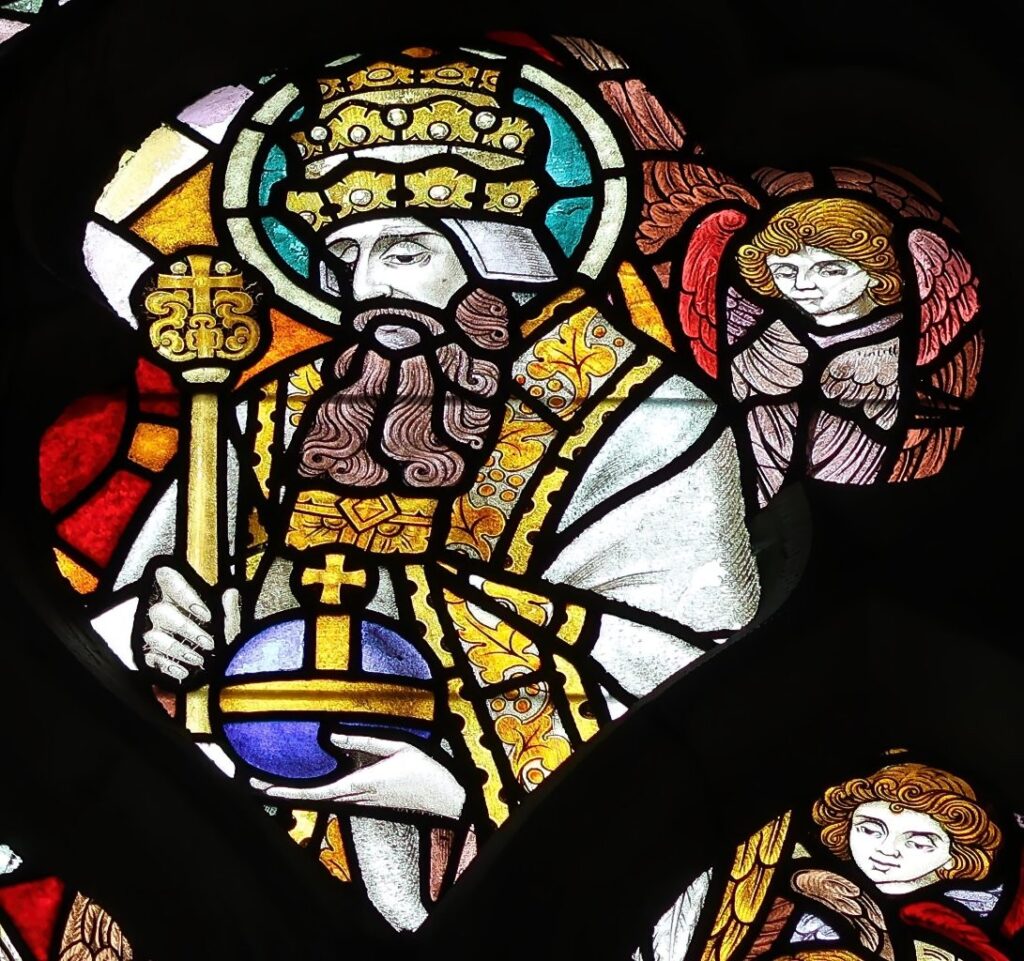
on the right we see an old man with a more papal crown but with and orb, symbol for worldly power: God the father.
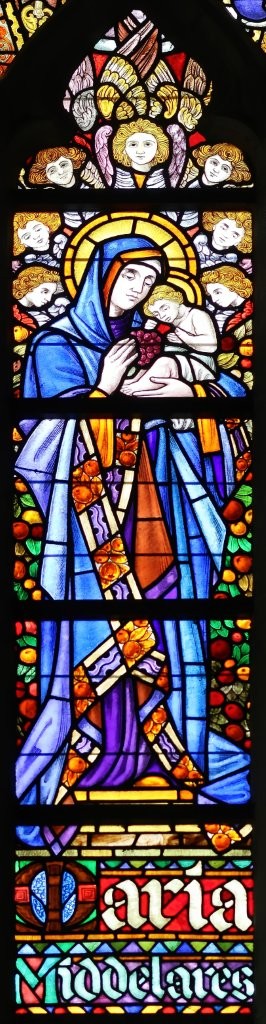
Below we see centrally in the middle Mary as intercessor (‘Middelares’ in Dutch), as she is interceding for humankind to God. She is the center around which this window evolves. around this figure are the 7 Sorrows of Mary.
The 7 Sorrows of Mary, is part of the veneration of Mary in the catholic church and focusses on 7 painful moments in the life of Mary. the prayer is there to help people when experiencing pain in their life, it shows Mary humbly suffering with Jesus.
The 7 moments are:
- The prophecy of Simeon
- The flight into Egypt
- The loss of Jesus as a 12 year old in the temple
- Mary meeting Jesus on the way to golgotha
- The crucifiction
- Jesus being taken from the cross, most often shown as ‘pieta’
- the burial of Jesus
so let’s take a look at each of the seven in this window, we begin at the top left.
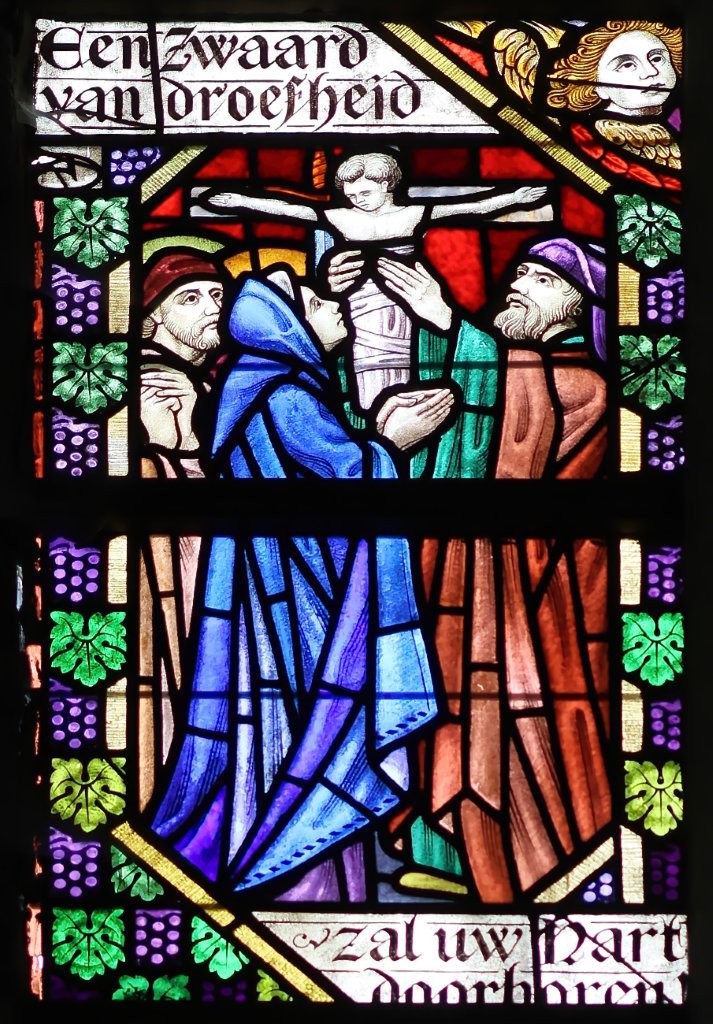
The first is the prophecy of Simeon in the temple, where the old Simeon praises God for being granted the chance to see his savior before he dies, but he also warns Mary, that a sword will pierce her heart, referring to the death of Jesus on the cross. The artist has depicted this by letting Simeon raises the little Jesus… on a cross. the text reads: ‘een zwaard van droefheid zal uw hart doorboren’ (a sword of sadness will pierce your heart’ referring to Luke 2:35.
Bible Text (Luke 2:25-35)
At that time, there was a man in Jerusalem whose name was Simeon. This upright and devout man was awaiting the consolation of Israel, and the Holy Spirit rested on him. 26 It had been revealed to him by the Holy Spirit that he would not experience death before he had seen the Christ of the Lord. 27 Prompted by the Spirit, Simeon came into the temple. When the parents brought in the child Jesus to do for him what was required by the Law, 28 he took him in his arms and praised God, saying: 29 “Now, Lord, you may dismiss your servant in peace,
according to your word; 30 for my eyes have seen your salvation, 31 which you have prepared in the sight of all the peoples, 32 a light of revelation to the Gentiles and glory for your people Israel.” 33 The child’s father and mother marveled at what was being said about him. 34 Then Simeon blessed them and said to Mary his mother: “This child is destined for the fall and rise of many in Israel, and to be a sign that will be opposed, 35 so that the secret thoughts of many will be revealed, and you yourself a sword will pierce.”
From Biblegateway NCB
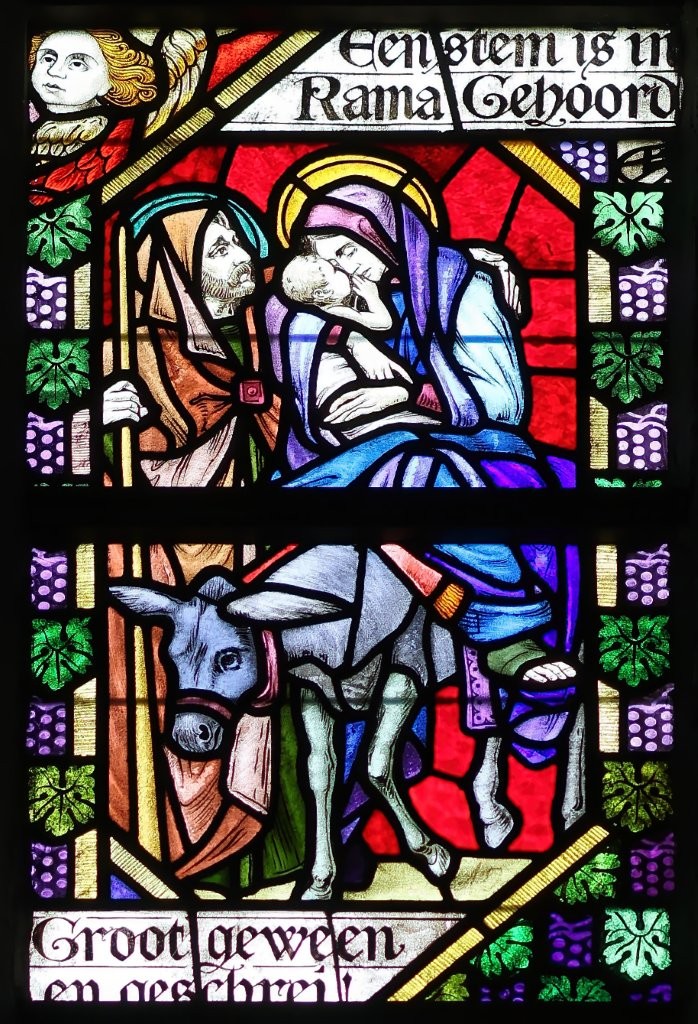
The next, on the top right, is the flight into Egypt. The text reads: “een stem is in rama gehoord groot geween en geschrei” – ” A voice was heard in Rama, Big crying and weeping”, referring to the words of Jeremiah that are quoted in the story of the slaughter of the Innocents in Bethlehem that prompted the flight into Egypt.
Bible Text (Matthew 2:13-18)
13 After the wise men had left, an angel of the Lord appeared to Joseph in a dream and instructed him, “Arise, take the child and his mother, and flee to Egypt. Remain there until I tell you. Herod seeks the child to kill him.” 14 Therefore, he got up, took the child and his mother, and departed that night for Egypt, 15 where they remained until the death of Herod. This was to fulfill what the Lord had spoken through the prophet: “Out of Egypt I called my son.” 16 When Herod realized that the wise men had deceived him, he flew into a rage and issued an order to kill all the boys in Bethlehem and the surrounding area who were two years old or less, in accordance with the information that he had obtained from the wise men. 17 Thus were fulfilled the words that had been spoken through the prophet Jeremiah: 18 “A voice was heard in Ramah, lamenting and sobbing bitterly:
Rachel weeping for her children, and refusing to be consoled, because they were no more.”
From Biblegateway NCB
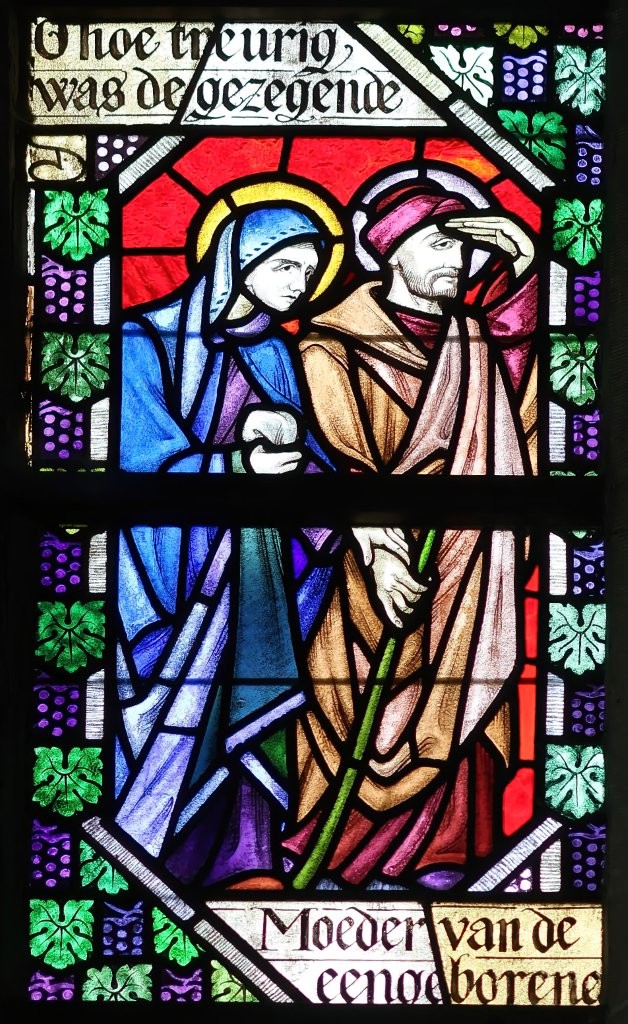
The third, on the left middle we see Mary and Joseph looking for Jesus (for three days) after he remained in the temple in Jerusalem
Bible Text (Luke 2:41-50)
41 Every year his parents used to go to Jerusalem for the feast of Passover. 42 And when Jesus was twelve years old, they made the journey as usual for the feast. 43 When the days of the feast were over and they set off for home, the boy Jesus stayed behind in Jerusalem. His parents were not aware of this. 44 Assuming that he was somewhere in the group of travelers, they journeyed for a day. Then they started to look for him among their relatives and friends, 45 but when they failed to find him, they returned to Jerusalem to search for him.46 After three days they found him in the temple, where he was sitting among the teachers, listening to them and asking them questions. 47 And all who heard him were amazed at his intelligence and his answers. 48 When they saw him, they were astonished, and his mother said to him: “Son, why have you done this to us? Your father and I have been searching for you with great anxiety.” 49 Jesus said to them, “Why were you searching for me? Did you not know that I must be in my Father’s house?” 50 But they did not comprehend what he said to them.
From Biblegateway NCB
The text reads “O hoe treurig was de gezegende Moeder van de eengeborene” which is not directly from the bible but is the translated 3rd verse from the Stabat Mater: “O quam tristis et afflícta fuit illa benedícta, mater Unigéniti!” (translation: O how sad and stricken was that blessed [woman], mother of the Only-begotten!).
The stabat mater is a 13th century hymn, directly linked to the cult of the our lady of sorrows. The hymn was put to music by many composers of classical music, but the one by Pergolesi is probably the most famous one.
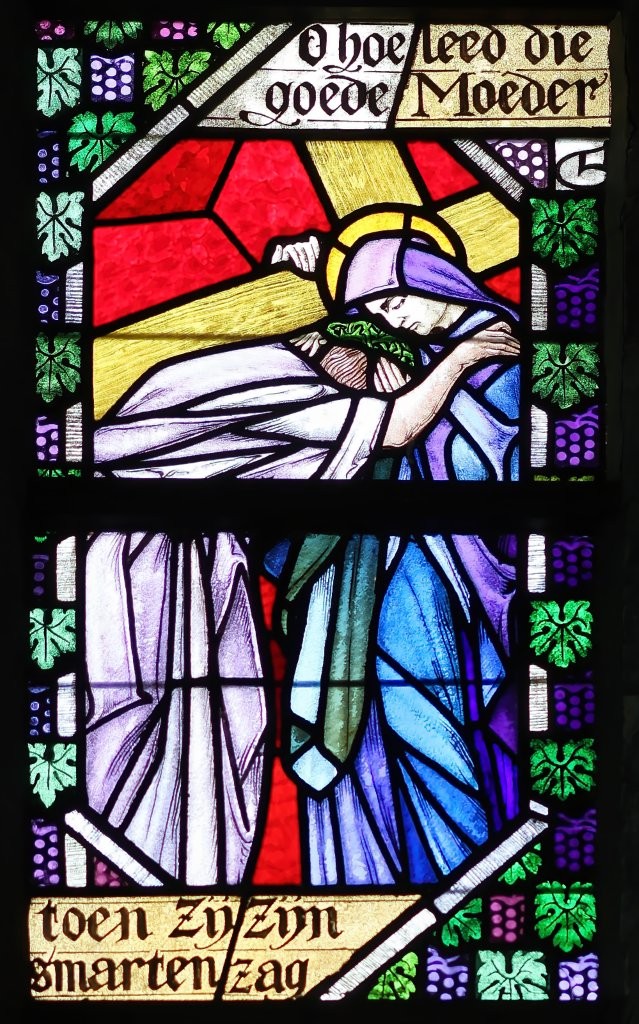
On the right side in the middle is the 4th scene, where Jesus meets his mother on the road to Golgotha. this scene is not literally mentioned in the Bible, but Luke mentions Jesus meeting the women of Jerusalem.
Bible Text (Luke 23:27)
27: A large number of people followed Jesus, among them many women who were mourning and lamenting over him
the accompanying text is again from the Stabat Mater, this time a loose translation of the 4th verse “O Hoe leed die goede moeder toen zij zijn smarten zag” – “O how that good mother suffered when she saw his sorrows” (Quae maerebat et dolebat, pia Mater, dum videbat nati poenas incliti.)
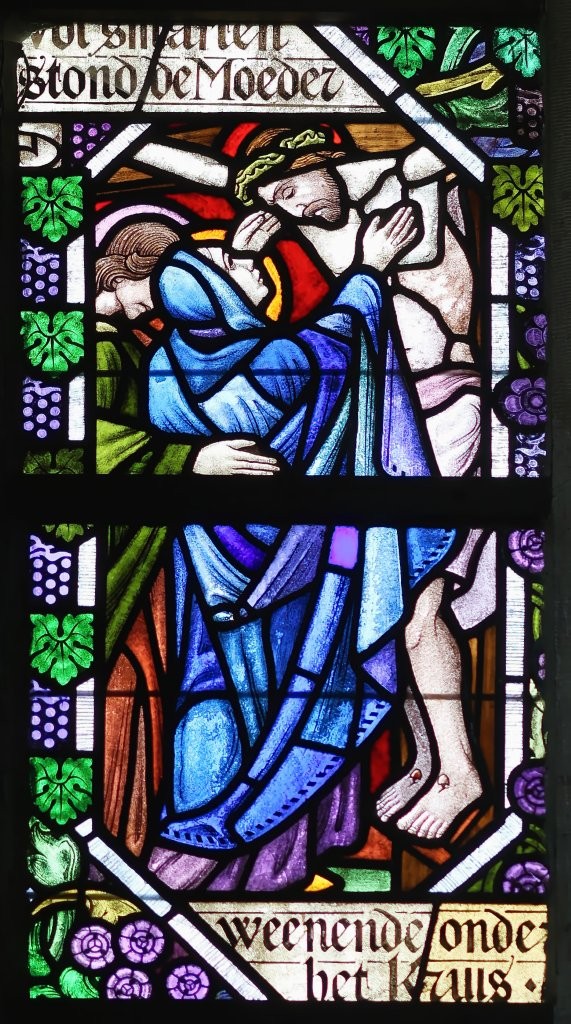
Again on the left, on the lower side we find the fifth scene, Mary (and John) standing at the cross.
Bible Text (John 19:26-27)
26 Standing near the cross of Jesus were his mother and his mother’s sister, Mary the wife of Clopas, and Mary Magdalene. 26 When Jesus saw his mother and the disciple whom he loved standing beside her, he said to his mother, “Woman, behold, your son.” 27 Then he said to the disciple, “Behold, your mother.” And from that hour the disciple took her into his home.
From Bible gateway NCB
The accompanying text is the opening verse of the stabat Mater: “Vol smarten stond de Moeder, weenende onder het kruis” – “Full of sorrows stood the mother,
weeping under the cross. (Stabat Mater dolorosa, iuxta Crucem lacrimosa…)
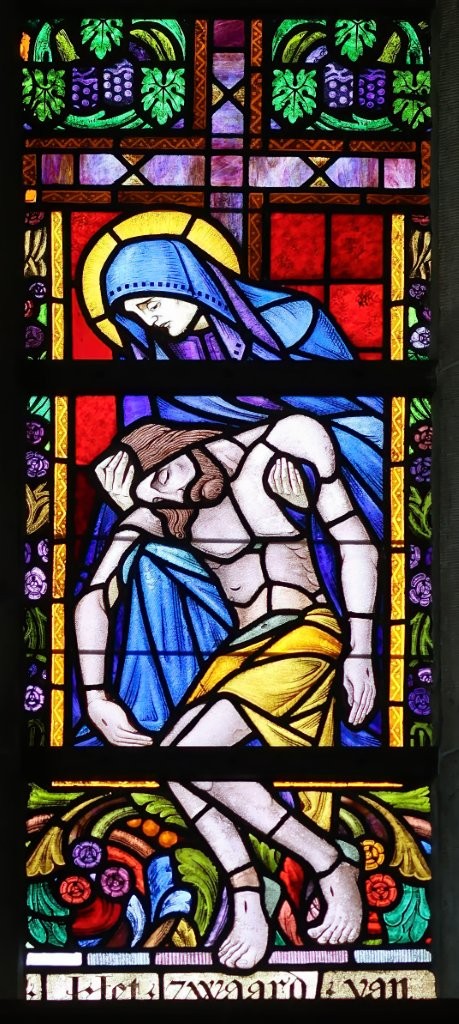
Below the main image of Mary as intercessor we have the 6th of the sorrows. Jesus is taken from the cross. Again this is not described in the bible, but it became part of tradition in the middle ages.
The text (though partially hidden behind the altar of the chapel) reads: “het zwaard van droefheid heeft haar hart doorboord” – “the sword of sadness has pierced her heart” this is a loose translation of the second verse of the stabat mater. (Cuius animam gementem, contristatam et dolentem, pertransivit gladius.)
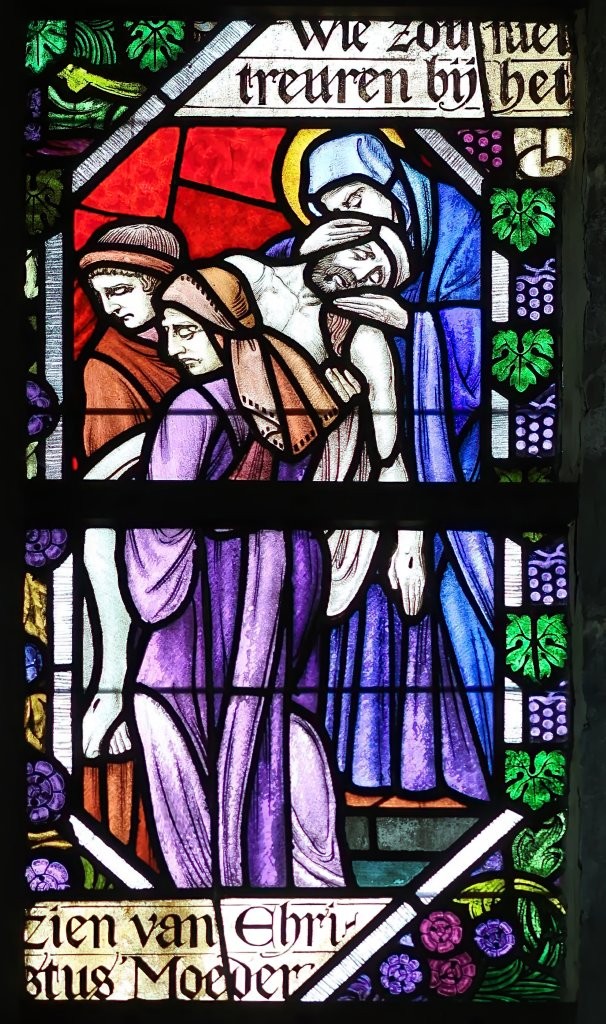
To the right we find the last of the seven sorrows: the burial of Jesus.
Bible Text(Mark 15:57-61)
57 When evening came, there arrived a rich man from Arimathea named Joseph, who had himself become a disciple of Jesus. 58 He went to Pilate and requested the body of Jesus. So Pilate ordered that it be handed over to him. 59 Joseph took the body, wrapped it in a clean linen shroud, 60 and laid it in his own new tomb that he had hewn out of the rock. He then rolled an immense stone against the entrance of the tomb and departed. 61 Mary Magdalene and the other Mary were there, sitting opposite the sepulcher.
From Biblegateway NCB
The text reads “wie zou niet treuren bij het zien Christus’ Moeder” – “who wouldn’t mourn at the sight of Christs mother” comes from the fifth verse of the stabat mater (Quis est homo qui non fleret, Matrem Christi si videret…)
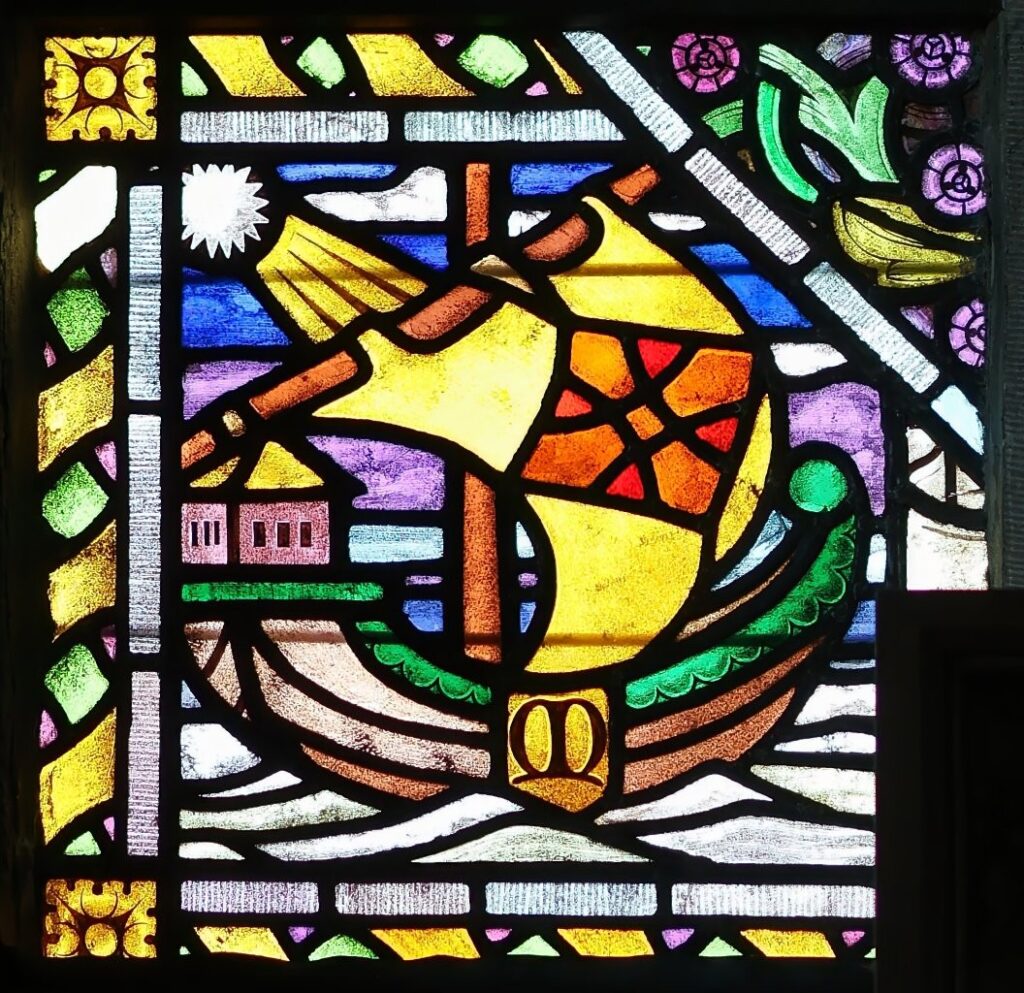
In the left bottom is an image of a ship with the letter M. I can not give a certain answer on the meaning of this. It may be a reference to a popular title of Mary “Stella Maris” (star of the sea). But more likely it may be symbolising a vessel (ship), with the meaning that Mary is the vessel of Gods salvation, as she carried Christ
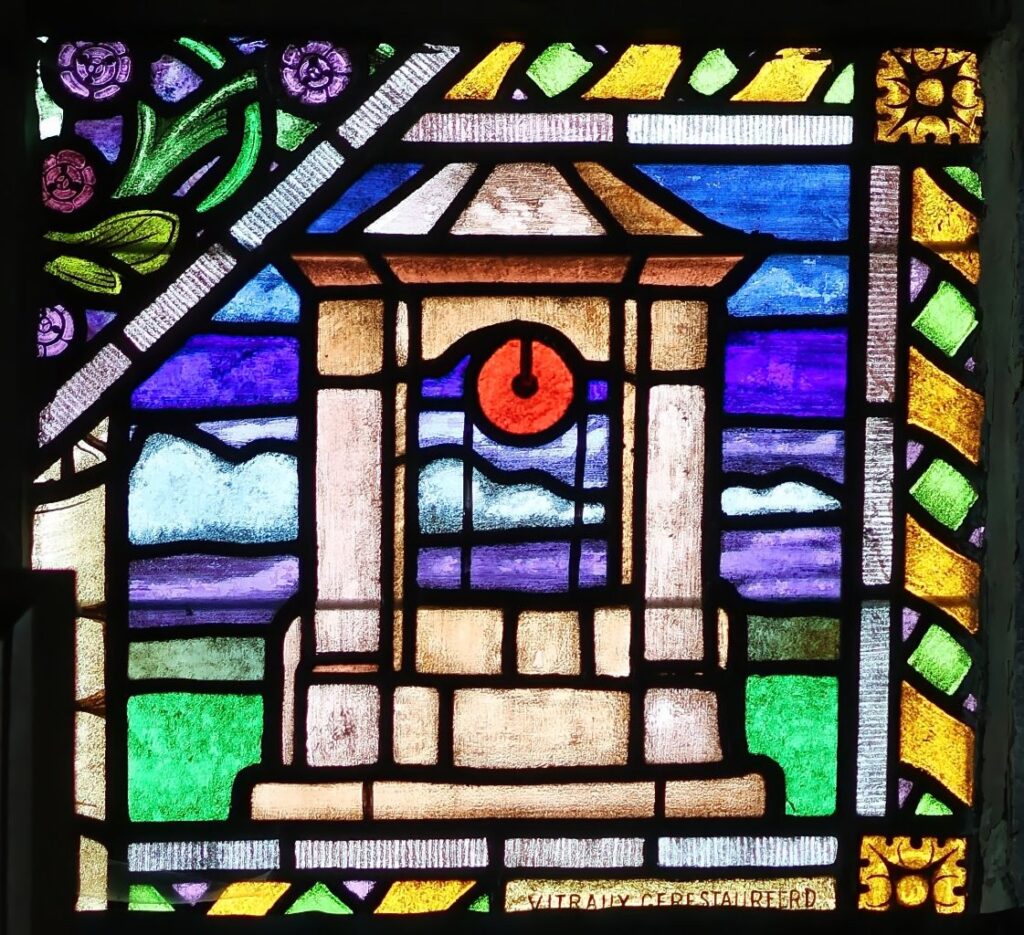
On the right side is a well. Again, I can’t be certain but the well may symbolise purity or a source where one can find refreshment and so symbolise Mary as a source of grace.
So going back to the total window, what is the message that the window tries to give to viewer.
In my humble opinion, the message is that Mary knows the suffering people experience in their life, she has known it herself, she is a source of grace, chosen as a vessel of salvation (having said yes to being the mother of Christ), and as she is intercessor, she brings the prayers to God above….
The church is unfortunately not open on an everyday basis, but masses are held every Sunday.
My special thanks to Martine Ronsse who allowed me to a private visit of the church to take the pictures.
Sources
De Sint-Eligiuskerk te Eine, een Romaanse kollegiale en haar crypte. Dr Patrick Devos, Gent 1993 (conatining a lot of information on the history of Eine and its church)
All photographs by me and copyrighted, taken on July 20th and July 27th 2026
2 responses to “BE-Eine-SintEligiuskerk-MaryWindow”
-
B
-
Dag Bart,
Proficiat met uw prachtige reportage!


Leave a Reply