Pieter Brueghels the procession to Calvary
Pieter Brueghel the elder was a Flemish painter, who was born around 1525-1530 and died in 1569, though only some 40 works remain, they are very famous for their detail, and the showing of life in the 16th century. He was also the father of painters Jan Brueghel (the elder) and Pieter Brueghel (the younger and grandfather of Jan Brueghel the younger, but Pieter Brueghel the elder is considered the greatest of the family. If one (like me) likes his paintings the Kunsthistorisches museum in Vienna is almost heaven as there are no less than 12 of his paintings, in one room. off course the museum has a lot of other great works as well, but there is no museum in the world that has more works by Pieter Brueghel the elder. among the works to be seen are the children’s games, the peasant wedding, the fight between carnival and lent, the building of the tower of Babel and the procession to calvary.
The work I want to go deeper into this time is the procession to calvary, painted in 1564. The work is 124×170 cm (49x67in) tall and is one of the larger paintings by him. Below is the complete painting.

The upper third is focussed as landscape on the lower part we see a lot of figures and a lot happening everywhere. The scene depicted is the moment from the Bible where Jesus is carrying the cross to calvary and Simon of Cyrene is forced to begin helping to carry the cross.
Bible text
Matthew 27:31 And when they had finished mocking him, they stripped him of the robe, dressed him in his own clothes, and led him away to crucify him. 32 As they went out, they encountered a man from Cyrene,named Simon, and they forced him to carry the cross. 33 When they came to a place called Golgotha, which means the Place of the Skull. […] 44 The thieves who were crucified with him also taunted him in the same way.
From Biblegateway NCB
Before we go in to more details, I think the painting has a very specific goal. It is wanting us to reflect, So I will share my thoughts, questions reflections, knowing full well I’m no specialist in history or theology, I think the painting is very rich, so let’s take a closer look to the details.
Also worth considering is that museums are generally not having an abundance of light, and no tripods allowed, so making pictures of the details (with zoom) handheld is a big challenge. So the results are not always razor sharp, unfortunately)
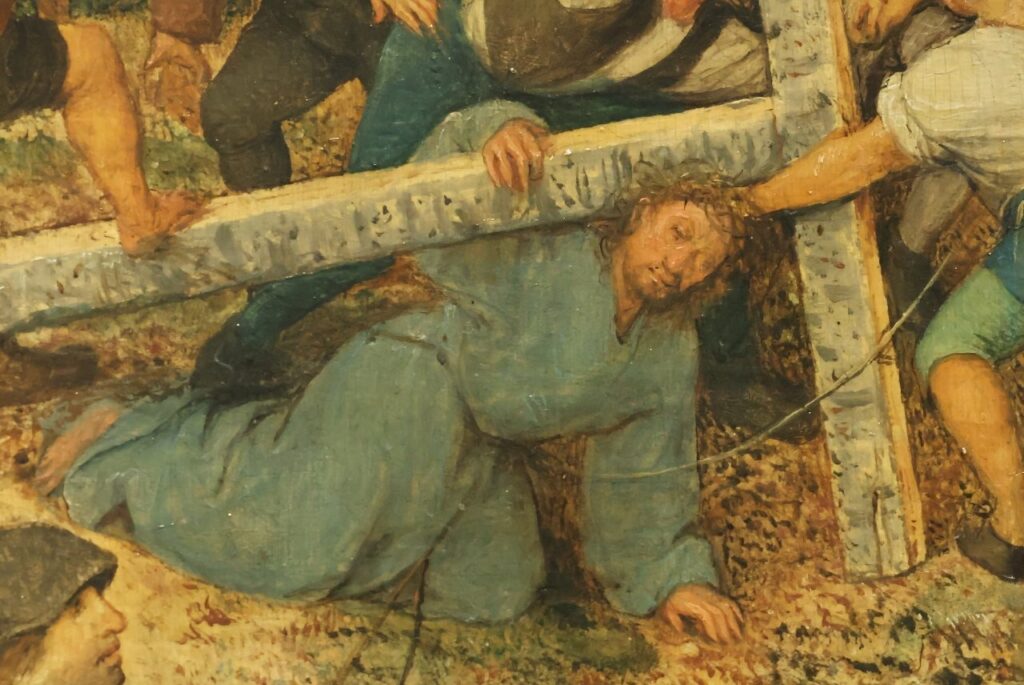
Let us start with the biblical figures. We can find Jesus just after he fell in the middle of the painting, but very small.
To the left, lower, almost at the side, there is a commotion, where Simon of Cyrene is pulled from his wife to go help Jesus.

Worth noting in this part of the scene is the lamb, tied, lying on the ground. Jesus is called the ‘lamb of God’ that is sacrificied for the sins of humankind. Maybe Simon and his wife were carrying this lamb. His wife also does not want it to happen and fights. Maybe she needs her husband to help carrying the jug that fell and other stuff? In a anachronism, we see her presented as a devout woman, with a rosary hanging on her side,
In the right bottom corner we see a group of larger figures, the only large figures in the painting.

They are kind of detached from all the fuss in the background, mourning.
In the middle we see Mary, Jesus’ mother, almost fainting.

A really beautifull detail is Mary’s hands, folded in prayer.

She is supported by the apostle John, foreshadowing the words of Jesus : “Woman, behold, your son.” and “Behold, your mother.” (John 19:25-27)
Bible text
John 19:25 Standing near the cross of Jesus were his mother and his mother’s sister, Mary the wife of Clopas, and Mary Magdalene. 26 When Jesus saw his mother and the disciple whom he loved standing beside her, he said to his mother, “Woman, behold, your son.” 27 Then he said to the disciple, “Behold, your mother.” And from that hour the disciple took her into his home.
From Biblegateway NCB

On her other side we see two women weeping, which are probably some of the other Marys, but not Mary Magdalene who is on the left side.
Bible text
Matthew 27:55 Many women were also present, looking on from a distance. They had followed Jesus from Galilee and ministered to him. 56 Among these were Mary Magdalene, Mary the mother of James and Joseph, and the mother of the sons of Zebedee.
From Biblegateway NCB

Going to the right from Jesus we see a cart with the two other criminals that were executed next to Jesus.
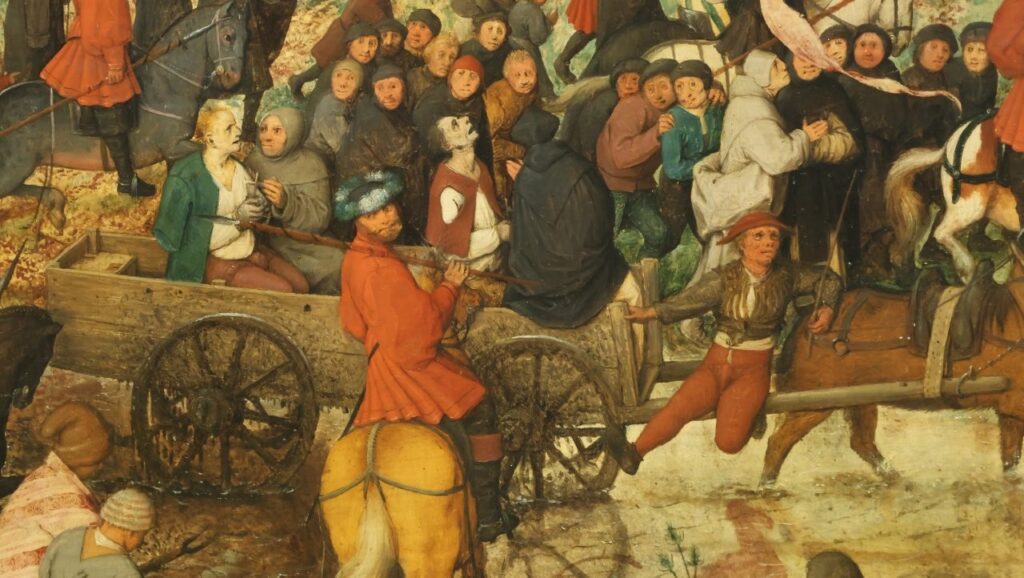
Both are very pale. and in another anachronism, both are accompanied by a friar hearing their confession. one is clinging to a cross, the “good” criminal that asked Jesus to remember him. (Luke 23:39-43)
Bible text
Luke 23:19 One of the criminals hanging there taunted Jesus, saying, “Are you not the Christ? Save yourself and us!” 40 But the other rebuked him, “Have you no fear of God, since you are under the same sentence? 41 In our case, we have been condemned justly, for we are getting what we deserve for our deeds. But this man has committed no wrong.” 42 Then he said, “Jesus, remember me when you come into your kingdom.” 43 Jesus said to him, “Amen, I say to you, today you will be with me in Paradise.”
From Biblegateway NCB
In the upper right we see Golgotha (the place of skulls)- the execution place. Two crosses are already waiting while preparations are made for the third cross.
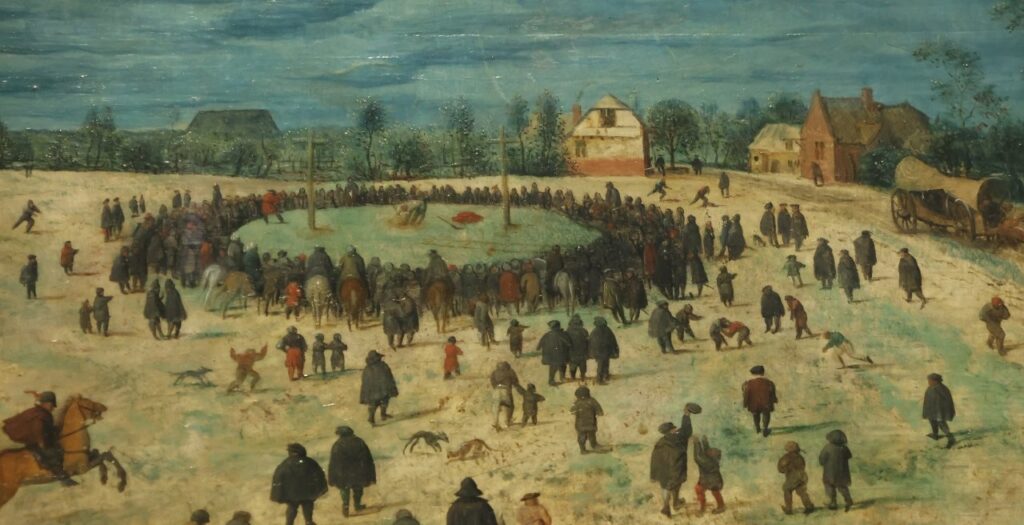
In our time we tend to represent these scenes as historically correct as possible. So we usually see Roman soldiers, 1st century Jewish dress and so on. But other artists will make the setting in modern times, which is what Brueghel did in this painting. All the rest is set in 16th century. He wants to bring it to his day.
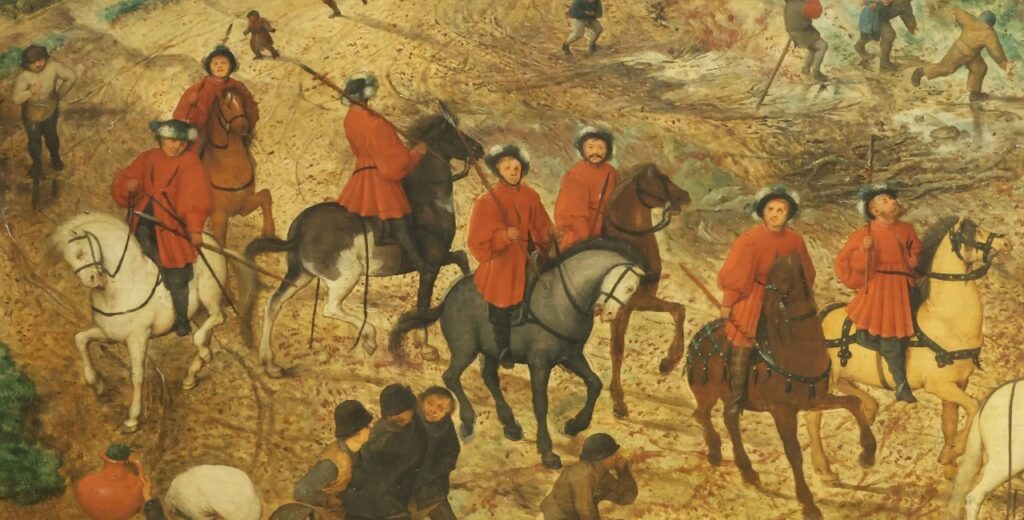
The 16th century was a turbulent time for Flanders, where Brueghel lived, as well as in other places, as the reformation is in full swing. Flanders (and the Netherlands) is under the rule of Spain, with Philips II as king, who has no tolerance at all for the protestant reformation. This tension will explode two years after the painting was painted, in 1566 in iconoclast riots (the ‘beeldenstorm’), and 2 years after that in the beginning of the 80 years war that will lead to the independance of the Netherlands. So in this painting the soldiers are Spanish, the soldier leading the cart holds a flag with traces of the imperial heraldry.

Another ‘translation to his times’ that Brueghel made is the presence of ‘the wheel’ it can most clearly be seen at the right side.

‘The breaking wheel’ was a capital punishment for the most serious crimes as it was killing by torture. The next part explaining this is not for sensitive readers
The breaking wheel
The execution went as follows, the condemned was tied on the scaffold and the executioner would break the victims bones one by one by hitting the bones with a large wheel. beginning with the legs, going up, then the arms going up. A ‘coup de grace’ could follow but did not have to, by a hit on the heart or neck, killing the condemned. In any case the body (alive or dead) would be tied to another wheel or even braided into the spoked wheel, and then put up a large pole. If alive the person, could suffer for days before dying.
The link with crucifiction is immediately clear as that was also an execution by torture, after which tradionally the bodies were left without burial. On the painting some bodies on the wheel can also be seen on the poles in the background.

Let’s now take a look at the other figures on the painting. We begin at the center bottom.

He looks like a wanderer that sells to make a living. Or maybe, he is a pilgrim going to Jerusalem?He takes a rest on the road and looks around to what is happening…

This man is running with a bag, has he stolen some of Simon’s goods? now that they are lying on the ground during the commotion of Simon being forced? or is he just in hurry?
To the right are two teenagers and a child, just looking at the commotion, but saying, ‘hey, let’s focus on the grapes and get out’

To their upper left are some other men, one holding his knive, just in case.

To the right are two others… “look what’s happening there’ but the other seems not really interested.


To the left, a whole group is looking at the commotion around Simon. Their faces are almost a caricature, but with a wide range of emotions: from pensive, surprised , indifferent to ‘well let’s see how this plays out’. A couple of children hide away under cloaks…
More to the left, young men run away with their bags and their dog. Have they taken something or are they just afraid to be next if they don’t succeed with Simon of Cyrene?
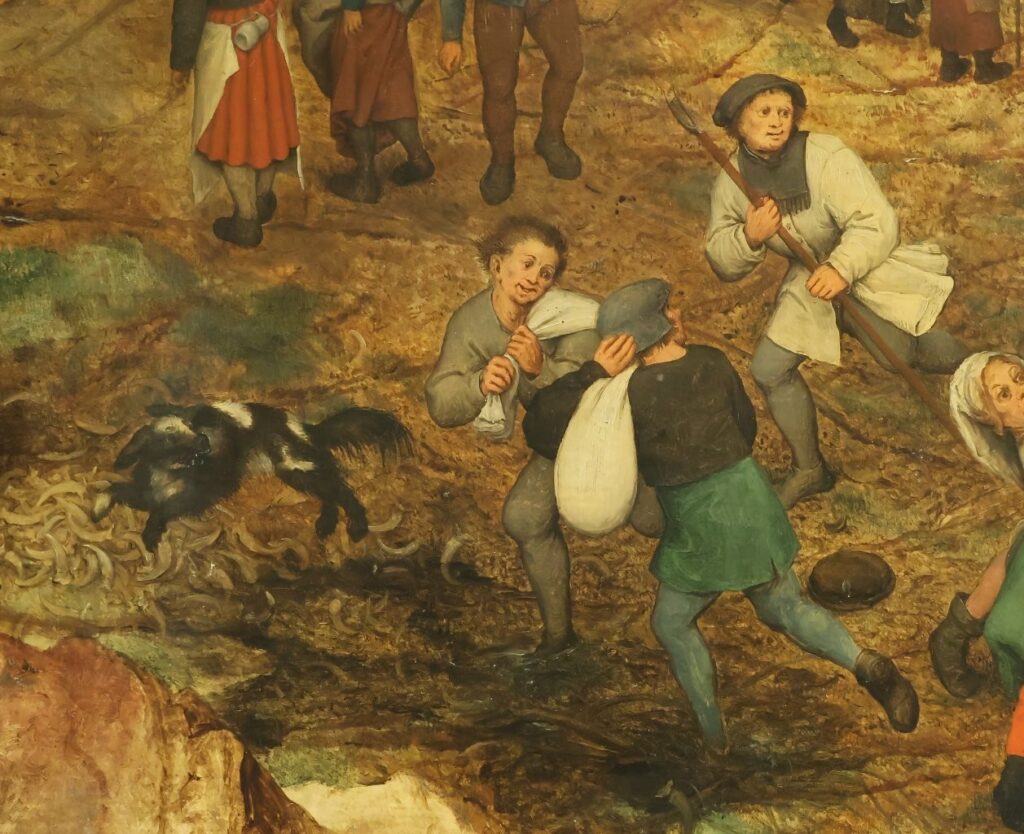
More to the left on top, some people return from, or go the market. The man looks back but the women move on.

Before them others continue undisturbed with their calves.

In the distance a lot more people are leaving the city
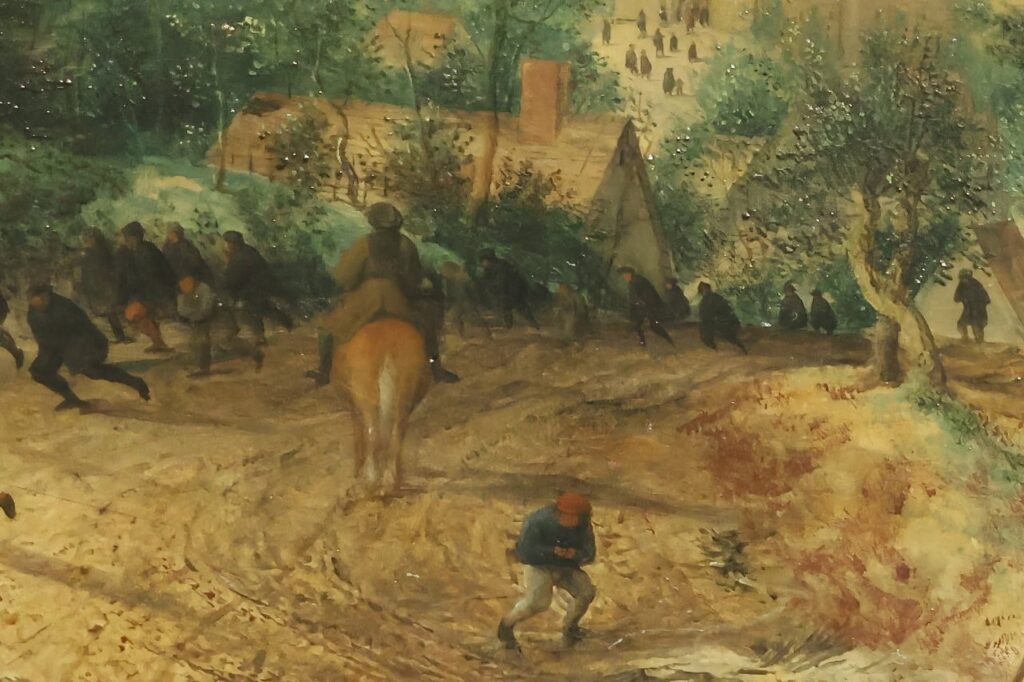
The city gate:

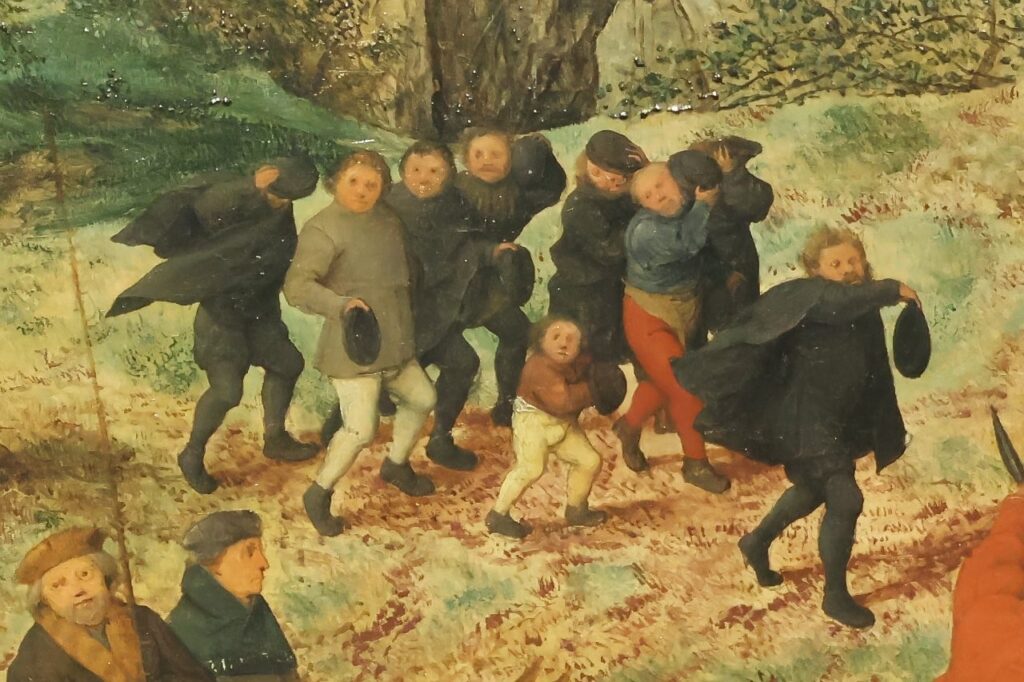
Moving back to the right, we see a group of youngsters joyfully walking and playing.

Before them is another group of different ages, waving their hats.
Below them, is the back end of the group of soldiers on horses.
Before them are richer people, with abundant clothing on horseback. At least one of the horses looks pretty exhausted.
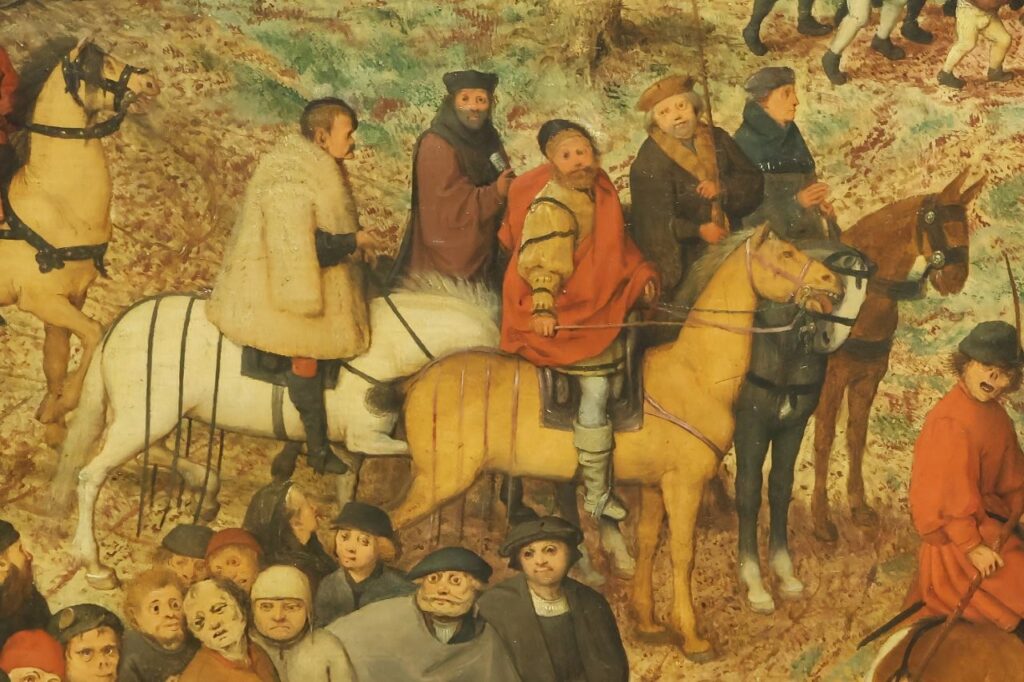
Moving to the lower right, another rider looks back, though his face also looks quite the character head.

To the right, two other riders look around checking everything, with serious faces, but the horse looks happier.

Moving further down right, we see several people. Some move further towards either the road somewhere else, or to the place of the execution. Three others are weeping for Jesus.

Next to one of the weeping women in the foreground, are a child and man trying to get her attention

And a praying woman.

Let’s now look at the people around Jesus. Here we see several people trying hard to get the cross out of the mud. One other seems to be blocking the effort by putting his foot on the cross.

In front of them is a man playing a horn or a flute in very exotic clothes. He fulfills his role of anouncing the procession.

The people around the cart are watching with a mix of excitement and surprise. It isalmost as if they were looking at a famous person. I gues nowadays they would be holding cellphones.
The cart is crossing a river. Is it a symbol for the river styx, the river from Greek mytholgy people crossed into the land of the dead? Or is it referring to the river Jordan, bringing the people of Israel back from Egypt to where they belonged?
We see a small girl wading cautiously through the river, keeping her clothes dry while a boy is pointing out the stones she can use to stay dry.

A little bit more down we see a man carrying a child over the river. Could he symbolise Saint Christopher, who according to legend carried a child over a river, that turned out to be Christ?

When we go to the right side, close to the tree, a group of people is watching it all, hidden away. Are they afraid of the soldiers, or o what is going to happen?

The man with the red hat is believed to be Brueghel himself, observing the scene in details.
Before them is a guard and some women with small children, keeping a safe distance.
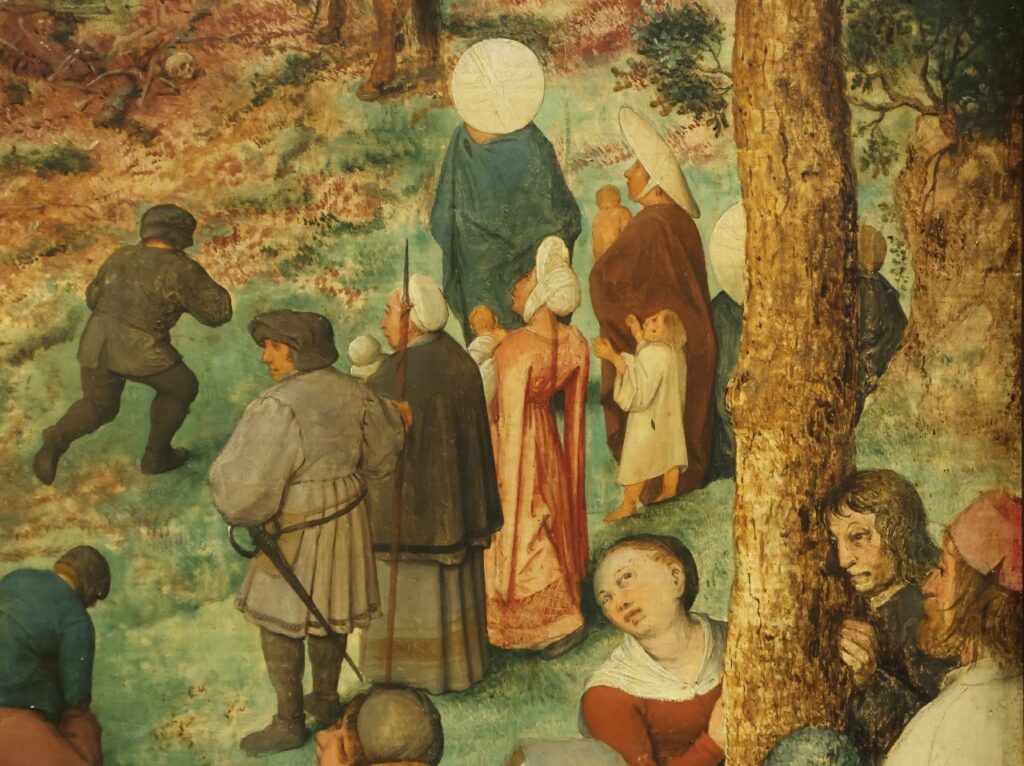
In front of them, a man with a walking stick and his dog.

And also soldiers on horseback keep watch.

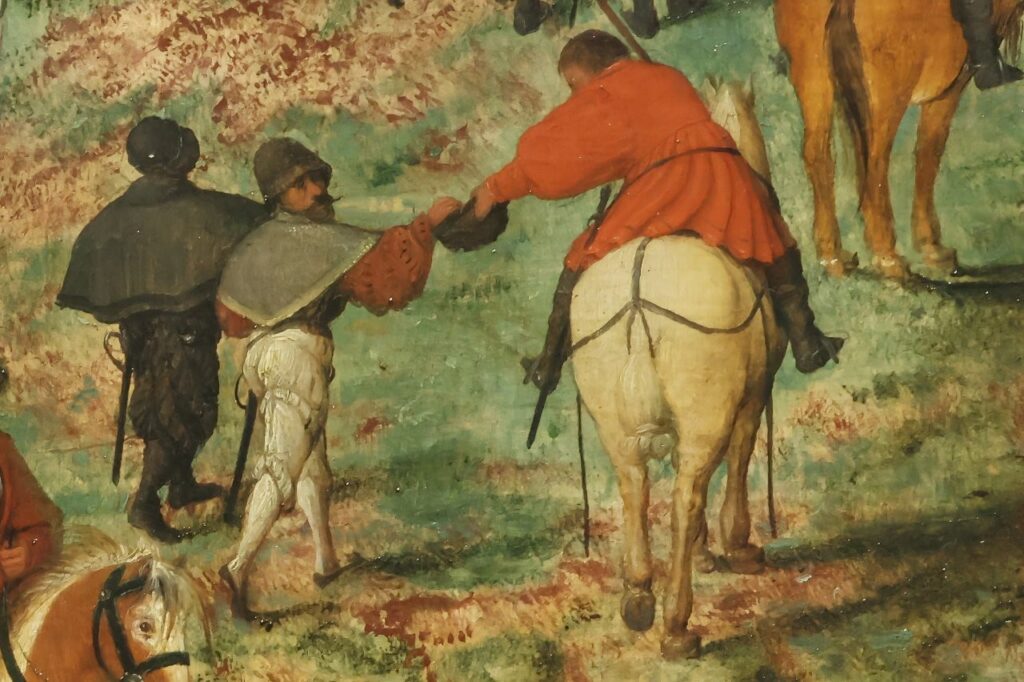

Some friends walk on, talking about it all, a smaller kid trying to keep up.
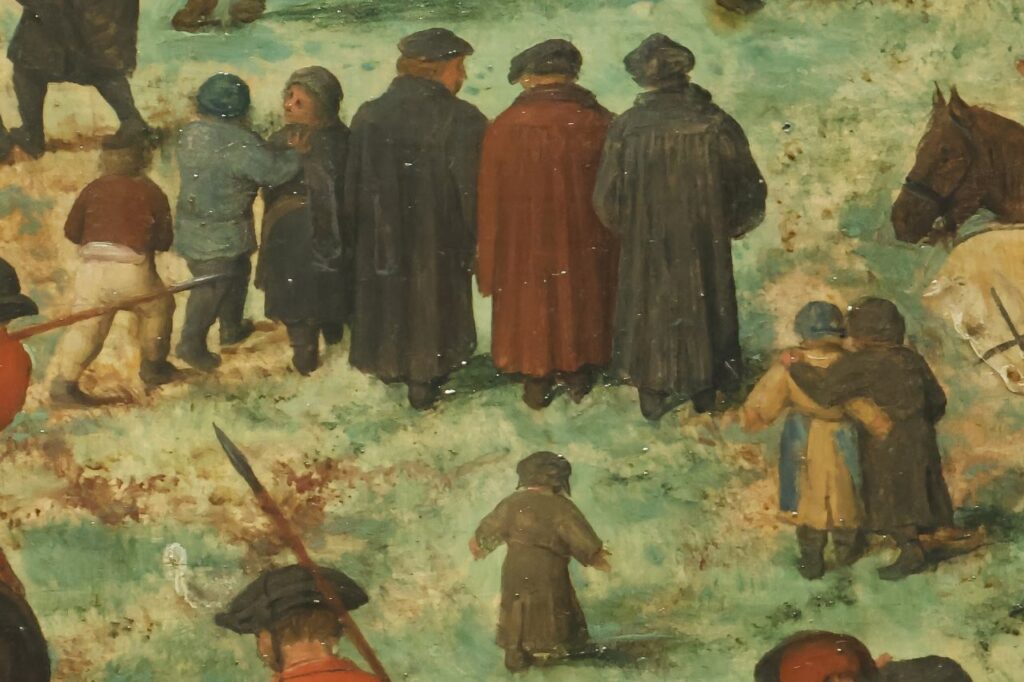
Some makie their point, raising their hands to the sky.

The women went ahead discussing som other topics.

Another is carrying a chaild on his back.

From the side, a group of youngsters with their dog look back, not sure what to think of it all.
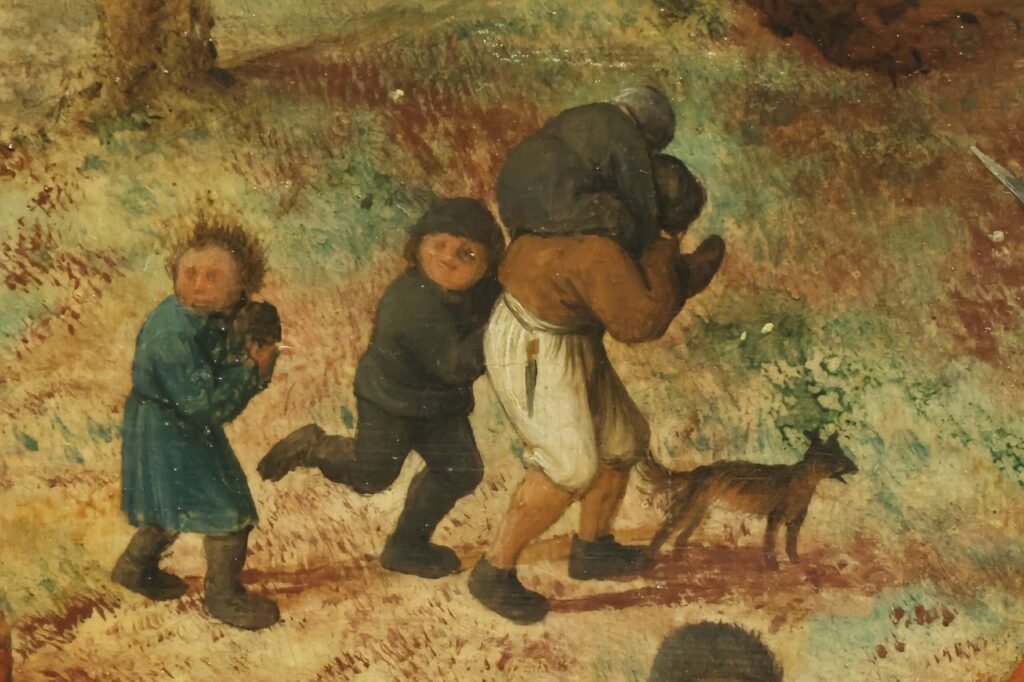
The closer we get, we see a crowd waiting, One is playfully holding a hat up from a child, Others are wrestling.

Or a rider is tying to keep his horse under control.

There is one more element worth noting. High up is a mill, and the miller is standing next to it. He is almost invisible, merely a few dots, overlooking it all, while the mill continues its circling pattern. The whole scene is also going in half a circle around this high vantage point.
In the film “The mill and the cross” by lech Majewski, the suggestion is made that this is a symbol for God, watching over it all…..
Manfred Sellink, in his book : “Bruegel in deteil” says that the mill, being crucial in the production of bread, is a symbol for the eucharist, for the bread of the last supper, also directing us to the sacrifice of Jesus on the cross.

In the end we are drawn back to the small figure in the center, of Jesus, looking at us.
it is as if He is asking us a question, together with the painter on the side of the painting.
They ask us: who are you in this painting?
what do you do when you see suffering, or injustice?
Do you look away?
Do you continue with your own business?
Do you refuse to help?
Do you like the prospect of a spectacle?
Do you see an opportunity?
Do you run away, to stay out of trouble?
Or do you mourn?
Or do you observe like Pieter Brueghel to be able to reprocuce what you saw?
So, who are you in this picture?
Sources and further reading
- The mill and the cross, 2011 film by Lech Majewski
- This article may be cited as Philip McCouat, “All life is here”: Bruegel’s Way to Calvary, Journal of Art in Society www.artinsociety.com link
- Manfred Sellink, Bruegel in detail – 2014 Ludion (book)
All pictures taken by me on 10th of November 2025 and under copyright
One response to “AT-Wien-KHM: Pieter Brueghel the elder – the road to Calvary”
-
Congratulations! You saw much more in the painting than I ever did. Thanks.

Leave a Reply